
SEO in Lebanon and the GCC: How to Rank on Google in 2026
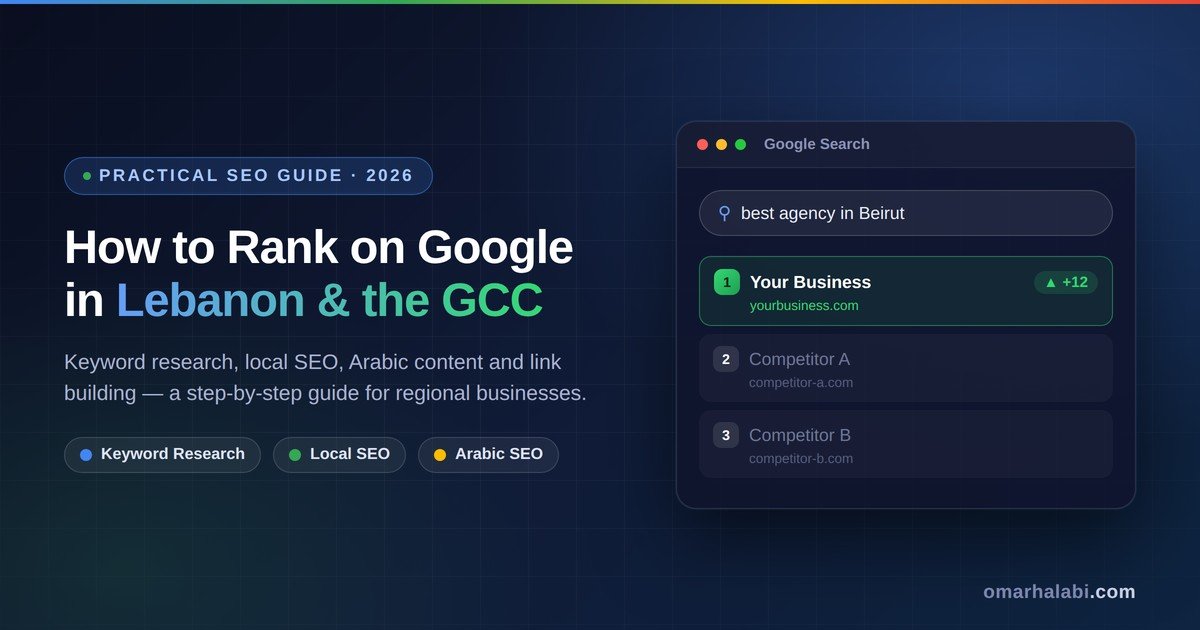
Short answer: SEO in Lebanon and the GCC comes down to four moves that matter more here than anywhere else: a fully built Google Business Profile, genuine Arabic content, pages that answer pricing and local questions directly, and a technically fast mobile site. Google handles over 95% of search in the region, most of it on phones, and most of your competitors have done none of this properly. That is the entire opportunity.
Every business owner in Beirut, Dubai and Riyadh has had the same experience. You build a website, you wait, and nothing happens. No calls, no forms, no traffic. The problem is almost never the website itself. It is that ranking on Google in this region follows different rules than the generic advice you read online, which was written for American and European markets.
This guide covers what actually works in 2026, with real costs and real timelines. And if you want to know what comes after ranking on Google, getting recommended by ChatGPT and Gemini, I cover that in my guide to AI search optimization for Lebanon and the GCC.
Why SEO in Lebanon and the GCC is a different game
Five regional realities change how you should approach SEO in Lebanon and the Gulf:
Search is bilingual, and sometimes trilingual. Your customers search in Arabic, English, and in Lebanon often French, switching languages depending on what they are looking for. A strategy that only targets English keywords is invisible to half your market.
Google is effectively the only search engine. Over 95% of search in the MENA region happens on Google. You do not need to think about Bing or anything else, but it also means Google’s local rules are the only rules.
Map search carries outsized weight. A huge share of commercial searches, “pharmacy near me”, “restaurant in Achrafieh”, “مكتب محاماة في بيروت”, resolve on Google Maps, not the classic results page. If your map presence is weak, you are losing customers you never knew existed.
Voice search in colloquial Arabic is growing fast. Younger users increasingly speak their searches in dialect rather than typing them in Modern Standard Arabic. Content that reflects how people actually talk captures queries your competitors’ formal content never will.
Few regional sites link out. Backlinks are harder to earn here than in the West, which sounds like bad news until you realise it means a modest, well-earned link profile beats most local competitors.
Local SEO in Lebanon: the fastest win for any business
If you do only one thing from this entire guide, do this. Local SEO delivers the fastest, cheapest visibility gains available to a business in Lebanon or the GCC, because the bar set by competitors is remarkably low.
Your Google Business Profile checklist
Work through this list and you will already be ahead of most businesses in your city. If you have not created a profile yet, start at Google Business Profile.
- Verify your listing. An unverified profile barely ranks. Complete the postcard, phone or video verification, whatever Google offers you.
- Use your full address, including the district. “Hamra, Beirut” outperforms just “Beirut” for neighbourhood searches, which is where buying intent lives.
- Upload 15 or more original photos. Real photos of your premises, team and work. Stock photos are ignored by users and discounted by Google.
- Post weekly. Offers, updates, completed projects. Activity signals a living business.
- Ask every happy customer for a review, and reply to all of them. Review volume, recency and your responses are among the strongest local ranking factors in the region.
- Write your service descriptions in both Arabic and English. You will be findable in both languages while competitors sit in one.
This same profile work pays twice: it is also the fastest way to appear in Google’s AI Overviews and Gemini answers, as I explain in the AI search guide.
Arabic SEO: the biggest untapped opportunity
Here is the number that should change your strategy: Arabic content online is a small fraction of what English enjoys, while hundreds of millions of people search in Arabic daily. The gap between demand and supply is the single biggest SEO opportunity in the region, and it applies doubly in AI search, where Arabic answers are even thinner.
How Arabic keyword research works
Do not translate your English keywords and call it research. Arabic speakers phrase searches differently, not just in different words. Switch Google’s interface to Arabic and study the autocomplete suggestions and “related searches” for your sector. Tools like Ahrefs and Semrush have improving Arabic databases, but Google’s own suggestions remain the most honest picture of what your region actually types.
Modern Standard Arabic vs dialect
This is the decision most guides skip. Modern Standard Arabic (فصحى) is right for formal pages: services, legal information, corporate content. But blog posts, FAQs and social content often perform better with a natural regional register, because that is how people search by voice and phrase casual queries. A Lebanese audience and a Saudi audience do not type the same words for the same thing. If you serve both, that is two keyword lists, not one.
RTL technical SEO
Arabic pages need proper right-to-left implementation, not a mirrored afterthought: dir="rtl" and lang="ar" attributes set correctly, hreflang tags connecting your Arabic and English versions so Google serves the right language to the right searcher, and a design actually tested in RTL. Machine-translated pages with broken RTL layouts do more harm than having no Arabic at all. If your site cannot support this cleanly, it may be time for a rebuild. My website development guide for Lebanon covers what that involves.
Keyword strategy that wins in the GCC
The pattern is simple: generic keywords are unwinnable, geo-modified and long-tail keywords are underpriced. Compare:
- “web design” → unwinnable against global players. “web design company in Beirut” → winnable, and the searcher is closer to buying.
- “gym” → hopeless. “ladies gym in Jounieh with personal trainer” → low volume, extremely high conversion.
- “lawyer” → forget it. “محامي عقارات في دبي” (real estate lawyer in Dubai) → precise intent, thin competition.
- “coffee” → nothing. “specialty coffee roaster Riyadh delivery” → a customer with a credit card out.
Build your pages around the specific, local, two-to-five-word phrases your real customers use. Ten pages each targeting one precise phrase will outperform one page stuffed with twenty.
Content that ranks in Lebanon and the Gulf
Five content types consistently earn rankings in this region because almost nobody local produces them properly:
Pricing guides. “How much does X cost in Lebanon” is searched constantly and answered honestly almost never. Publish real ranges. It filters bad leads and earns the click every time.
Comparison posts. “X vs Y for businesses in the UAE”: decision-stage searches with buying intent and thin competition.
Local regulation and process guides. How to register a company, what a municipality requires, how VAT applies. Evergreen, linkable, and precisely local.
Neighbourhood and city guides. Content tied to Hamra, Achrafieh, JBR or Olaya captures map-adjacent searches competitors ignore.
Case studies with numbers. “How we increased a Beirut restaurant’s bookings 40%” beats ten generic service pages. Real work with real results, the kind of thing that belongs in a portfolio, is both content and proof.
Whatever you write, put the answer in the first two sentences under each heading. That style now decides whether AI assistants quote you, and it has always been what impatient human readers wanted anyway.
Technical SEO fundamentals you cannot skip
None of the above works on a broken foundation. The non-negotiables:
- Core Web Vitals in the green. Aim for LCP under 2.5 seconds on mobile; Google’s own Core Web Vitals guide explains the thresholds. Regional hosting or a CDN with Middle East nodes makes a real difference here.
- Mobile first, genuinely. More than 80% of MENA web traffic is mobile. Test your site on a mid-range Android over 4G, not your office fibre.
- HTTPS everywhere. Still occasionally missing on Lebanese business sites in 2026, still an immediate trust killer.
- Schema markup. LocalBusiness, Organization, FAQ and Article structured data help Google, and AI models, understand exactly what you are.
- XML sitemap submitted in Search Console. And check it actually updates when you publish.
If a site rebuild is on the table anyway, build these in from day one rather than patching them later. The difference in cost is substantial, as covered in the website development guide.
Building backlinks in a region where few sites link out
Regional link building is harder than Western guides suggest, but five approaches reliably work:
- Regional directories that carry weight. Quality Lebanese and Gulf business directories, chamber of commerce listings, and sector platforms. Accuracy and consistency matter more than volume.
- Guest contributions to regional publications. Business and tech publications in Beirut, Dubai and Riyadh accept expert columns far more readily than saturated Western outlets.
- Sponsoring local events and organisations. Sponsorships almost always come with a link, and regional event sites tend to have real authority.
- Publishing original data. A simple survey or price index for your industry in Lebanon becomes the source everyone else cites.
- Journalist requests. HARO-style platforms and direct relationships with regional journalists convert expertise into authoritative links.
Ten earned regional links will outperform a hundred purchased ones, and purchased links are the fastest way to lose everything you built.
What SEO in Lebanon and the GCC costs in 2026
Honest numbers, since almost nobody publishes them. Professional SEO in Lebanon typically runs $400 to $1,200 per month depending on competitiveness and scope. In the UAE and Saudi Arabia, expect $800 to $2,000 monthly for equivalent work. Competitive keywords take 6 to 12 months to rank; anyone promising page one in 30 days is selling you a penalty waiting to happen.
Treat SEO as a compounding asset, not a monthly expense. The rankings you earn in year one keep delivering customers in year three, which no ad budget can claim. If you want a sense of what that investment should include, my SEO services in Lebanon page shows how I structure it.
The next layer: from ranking on Google to being recommended by AI
Ranking on Google is no longer the finish line. A growing share of your customers now ask ChatGPT, Gemini or Perplexity who to hire, and those tools name two or three businesses, not ten blue links. Everything in this guide is the foundation for that too, but AI visibility has its own additional playbook: entity consistency, citations, answer-first content and schema. I have written a full guide to AI search optimization for Lebanon and the GCC covering exactly how to get your business into those answers.
Final thoughts
SEO in Lebanon and the GCC rewards the businesses willing to do unglamorous work consistently: a complete Google Business Profile, real Arabic content, honest pricing pages, a fast mobile site and a handful of earned regional links. None of it is complicated. Almost none of your competitors are doing it. That combination is rare in marketing, and it will not last forever.
If you would rather have it done properly than do it yourself, that is what my SEO services in Lebanon cover, or get in touch for a free review of where your site stands.
Frequently Asked Questions
How long does SEO take to work in Lebanon and the GCC?
Expect 3 to 6 months for local SEO results and 6 to 12 months for competitive keyword rankings. Google Business Profile improvements often show within weeks, which is why local SEO should always come first. Anyone promising first-page rankings in 30 days is using tactics that will eventually get your site penalised.
How much does SEO cost in Lebanon?
Professional SEO in Lebanon typically costs $400 to $1,200 per month depending on your industry’s competitiveness and the scope of work. In the UAE and Saudi Arabia, equivalent services run $800 to $2,000 monthly. One-off SEO audits and technical fixes are usually priced as projects rather than retainers.
Is Arabic SEO worth the investment?
Yes. For most regional businesses it is the highest-return move available. Arabic content online is scarce relative to the volume of Arabic search, so competition is a fraction of what English keywords face. The requirement is native-quality Arabic with proper RTL implementation and hreflang tags. Machine translation does more harm than good.
Should I target Lebanon and the GCC with one website or separate sites?
One website with properly structured language and location targeting is usually right for small and medium businesses. Use hreflang tags for language versions and dedicated location pages for each market. Separate country domains only make sense once you have physical operations and dedicated teams in multiple countries.
What is the most important SEO factor in 2026?
For regional businesses: answering local questions directly on a fast mobile site, backed by an active Google Business Profile. Google’s systems, and now AI assistants, reward content that resolves a query immediately. The businesses winning in Lebanon and the GCC are the ones publishing direct answers about prices, processes and locations that competitors keep vague.
Does SEO still matter now that people ask ChatGPT instead of Google?
Yes. More, not less. AI assistants build their answers from the same signals SEO develops: crawlable content, structured data, consistent business information and third-party citations. Strong SEO is the prerequisite for AI visibility, and the additional work on top of it is covered in my AI search optimization guide.
Who can do SEO in Lebanon for my business?
An agency, a freelancer, or you. Agencies suit large companies with many markets; freelancers suit businesses that want one accountable person and a fixed fee. I run SEO services in Lebanon as the developer who also builds the site, so technical fixes get implemented rather than emailed as recommendations. Whoever you choose, ask to see a ranking they earned and a report they send, not a promise.
Written by
Web developer & digital advisor, Beirut
Keep reading
More guides for Lebanon & the GCC
Web Development · Sep 27, 2026 · 12 min read
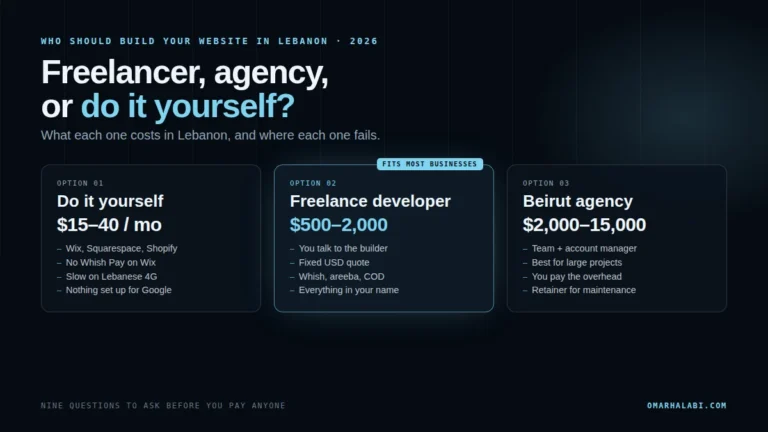
Who Should Build Your Website in Lebanon? Freelancer, Agency or DIY (2026)
Short answer: if you want to hire a web developer in Lebanon, you have three real options. A freelance developer costs $500 to $2,000, you deal with…
Web Development · Sep 24, 2026 · 8 min read
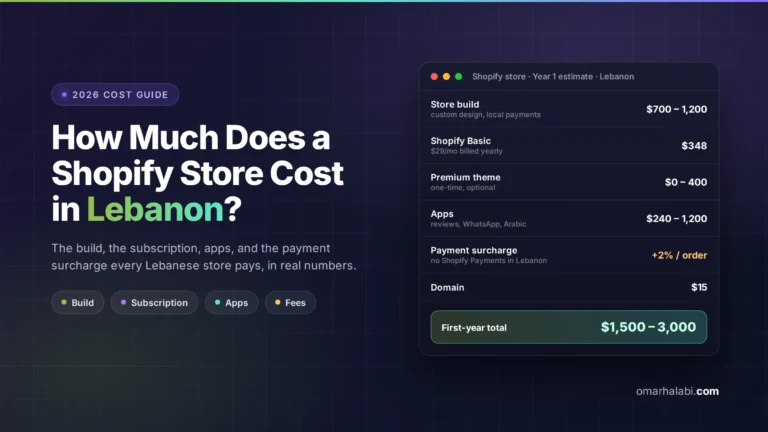
How Much Does a Shopify Store Cost in Lebanon? (2026 Guide)
Asking how much a Shopify store costs in Lebanon gets you two very different answers. Shopify's own pricing page shows a monthly plan. A developer's quote shows a…
Web Development · Sep 24, 2026 · 10 min read
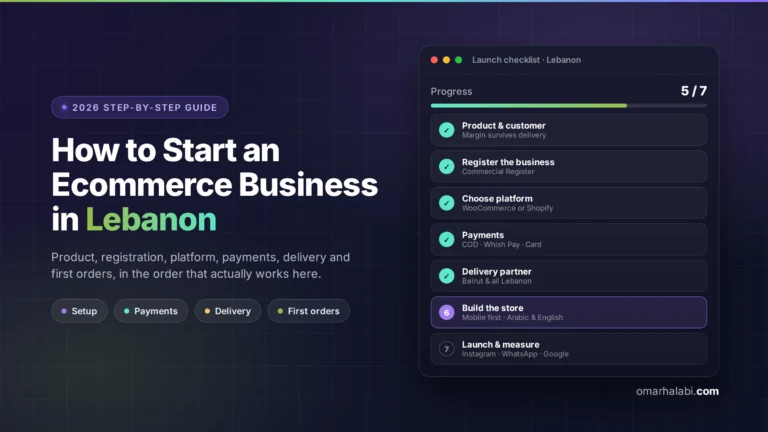
How to Start an Ecommerce Business in Lebanon: Step-by-Step Guide (2026)
If you want to start an ecommerce business in Lebanon, you are entering one of the strangest and most resilient online markets in the region. Global processors do…
Read enough?
Let's build the real thing.
You'll speak directly with Omar. Free consultation, fixed USD quotes.