
Website Development in Lebanon: 2026 Business Guide
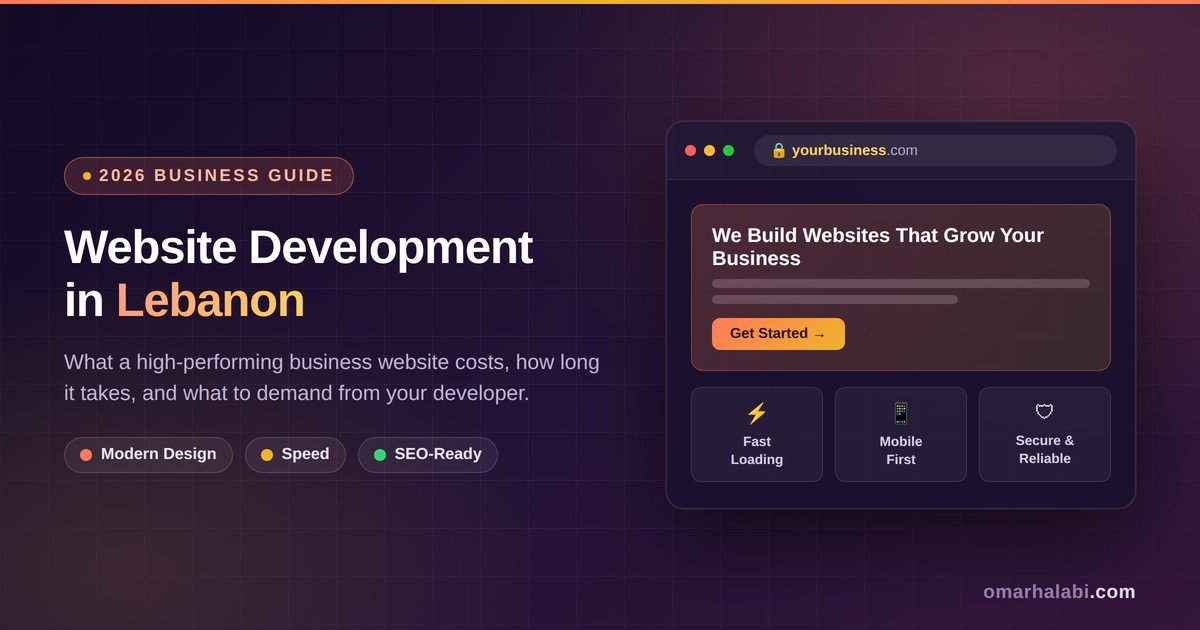
If you run a business in Lebanon and you are thinking about building or rebuilding your website, 2026 is a very different landscape than even two years ago. Between fluctuating exchange rates, unreliable electricity, patchy internet, and customers who increasingly expect a mobile-first experience, your website has to work harder than ever just to compete.
This guide walks you through exactly what a Lebanese business needs to know before starting a web project. It covers realistic pricing in both USD and LBP, timelines you can hold a developer to, which hosting and payment options actually work from Beirut, and the specific design choices that convert Lebanese and GCC audiences. No fluff, no sales pitch — just the details I wish every client knew before their first meeting with a developer.
Why Lebanese Businesses Need a Website More Than Ever in 2026
The local market has shifted decisively online. Walk through any souk in Beirut, Tripoli, or Saida and you will see small businesses with active Instagram pages but no website. That worked in 2020. It does not work now.
Here is what changed. Customers in Lebanon and the GCC now Google a business before they call. If you do not show up — or if your Instagram bio is the only thing they find — you lose trust instantly. Worse, when a GCC customer (a Lebanese expatriate in Dubai, Jeddah, or Kuwait) wants to order from home, a WhatsApp chat is not enough. They want a proper catalog, clear shipping info, and a way to pay.
The Real Competitive Pressure
Competitors across the border are investing heavily in their digital presence. A restaurant in Dubai has a booking system, multilingual menu, and Google Maps integration. If your restaurant in Hamra still relies on a WhatsApp number, you are losing customers before they even decide where to eat.
Expatriate and Diaspora Revenue
The Lebanese diaspora is your largest untapped customer segment. They want to buy products, book services for their families back home, and send gifts. A proper e-commerce website with international shipping and a dollar-denominated checkout captures that revenue. A Facebook page does not.
How Much Does Website Development Cost in Lebanon?
This is the first question every business owner asks. The honest answer depends on what you actually need, but here are realistic 2026 ranges based on projects delivered across Beirut and the GCC.
Small Business Website (5 to 10 pages)
Expect to pay between 500 and 1,000 USD for a professional, responsive website with SEO basics, contact forms, and WhatsApp integration. This suits restaurants, clinics, law firms, small retailers, and service businesses. Timeline is typically 2 to 4 weeks.
E-commerce Store
A proper online store with product catalog, inventory, payment integration, and shipping logic ranges from 2000 to 4,000 USD. Using WooCommerce or Shopify keeps costs lower; custom platforms cost more. Timeline is 4 to 8 weeks.
Custom Web Application or Booking Platform
Anything involving user accounts, dashboards, bookings, or custom workflows starts at 5,000 USD and scales with complexity. Expect 6 to 12 weeks for delivery.
What Actually Matters in a Lebanese Website Design
Generic design advice from US or European blogs does not translate cleanly to our market. Here is what genuinely moves the needle for Lebanese and GCC audiences.
- Bilingual from day one: Arabic and English must both be first-class citizens, not an afterthought. RTL layout for Arabic has to look as polished as the English version.
- WhatsApp as the primary contact method: a floating WhatsApp button converts significantly better than email forms in this region.
- Fast loading under weak connections: your site must load under 3 seconds even on 3G. Optimized images, minimal JavaScript, and good caching are non-negotiable.
- Local payment options: Whish, OMT, and bank transfer for Lebanon. Mada, STC Pay, and Apple Pay for Saudi Arabia. PayPal for diaspora customers.
- Mobile-first design: over 80% of traffic in the MENA region comes from phones. If it does not look perfect on an iPhone, it does not exist.
Choosing the Right Hosting for a Lebanon-Based Business
Hosting in Lebanon specifically is rarely the right choice. Local hosts struggle with uptime and speed. Instead, host on a global provider with servers close to your audience.
For Lebanon-Focused Businesses
Use hosts with European data centers (Frankfurt or Amsterdam). SiteGround, Hostinger, and Cloudways all offer this. Add Cloudflare as a CDN to handle Lebanon’s variable internet quality.
For GCC-Focused Businesses
Pick a host with Middle East or Asian data centers. AWS Bahrain region, Google Cloud Dammam, or any provider with a Dubai point of presence will outperform European hosts for your Gulf traffic.
Payment Gateways That Actually Work From Lebanon
This is the single biggest technical headache for Lebanese e-commerce. Stripe officially does not support Lebanese businesses. PayPal is restricted. Here is what actually works in 2026.
- Whish Money for local LBP and USD transactions — widely adopted, fast to integrate.
- Areeba or NetCommerce for card processing tied to a Lebanese merchant account — requires a bank relationship.
- 2Checkout or Paddle for international card payments using a US or EU company structure — the cleanest option if you serve diaspora customers.
- Cryptocurrency via Coinbase Commerce or BitPay — still niche but growing among Lebanese online stores.
- Cash on delivery handled through Aramex, Wakilni, or Bosta — essential for the domestic market where card trust is still building.
Timelines You Should Hold Your Developer To
One of the most common complaints I hear from business owners in Beirut is: my developer disappeared for weeks. Here is a realistic milestone schedule for a professional web project.
- Week 1: discovery, wireframes, and content gathering signed off.
- Week 2 to 3: design mockups approved, development environment set up.
- Week 4 to 5: core pages built, content populated, mobile responsive tested.
- Week 6: SEO setup, speed optimization, cross-browser testing, client review.
- Week 7: launch, Google Search Console submission, and training handover.
Red Flags When Hiring a Web Developer in Beirut
- No portfolio of live, working websites you can visit and test yourself.
- Pricing that feels suspiciously low — under 200 USD for a full site usually means a template with no customization.
- Refuses to give you admin access to your own WordPress or Shopify account.
- Cannot explain SEO basics in plain language.
- Uses only email for communication — in Lebanon, responsive developers use WhatsApp for updates.
Final Thoughts
A website built correctly for the Lebanese and GCC market in 2026 is one of the highest-return investments a business can make. It captures diaspora revenue, builds trust with local customers, and puts you ahead of competitors still relying on social media alone. But cutting corners on design, payment integration, or hosting will cost you more in lost sales than you saved on the build.
Take the time to get the foundations right. Your website will carry your business for years.
Ready to move forward? Contact Omar Halabi on WhatsApp at +961 70 884 941 or email info@omarhalabi.com for a free consultation — serving Lebanon, UAE, Saudi Arabia, Kuwait, Qatar, Bahrain, and Oman.
Frequently Asked Questions
How much does a basic business website cost in Lebanon in 2026?
A professional 5-to-10 page business website in Lebanon costs between 500 and 1,000 USD in 2026, depending on design complexity, number of pages, and whether you need bilingual Arabic and English content. Simple template-based sites can be cheaper, but rarely perform well for SEO or conversions.
How long does it take to build a website in Lebanon?
A small business website takes 2 to 4 weeks to build from initial brief to launch. E-commerce stores take 4 to 8 weeks. Custom web applications with user accounts, bookings, or dashboards take 6 to 12 weeks.
Can I accept online payments from my Lebanese website?
Yes. You can use Whish Money, Areeba, NetCommerce, or 2Checkout depending on your setup. Stripe does not officially support Lebanese businesses, but alternatives are mature and widely used in 2026.
Should I host my website in Lebanon or abroad?
Host abroad on a reputable provider with European or Middle East data centers, and add Cloudflare as a CDN. Local Lebanese hosting typically has uptime and speed issues that hurt both user experience and Google rankings.
Do I need both an Arabic and English version of my website?
If you serve clients in Lebanon and the GCC, yes. Arabic SEO captures a massive untapped audience, and a proper RTL layout signals professionalism. English alone limits your reach significantly across the Gulf.

Written by
Web developer & digital advisor, Beirut
Keep reading
More guides for Lebanon & the GCC
SEO & AI Search · Oct 8, 2026 · 10 min read
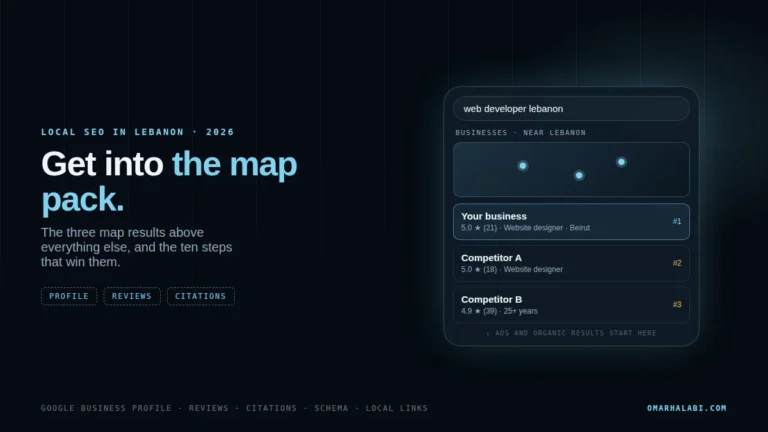
Local SEO in Lebanon: How to Get Into the Google Map Pack (2026)
Short answer: local SEO in Lebanon is the work of getting your business into the Google map pack, the three map results that appear above everything else…
SEO & AI Search · Oct 8, 2026 · 10 min read
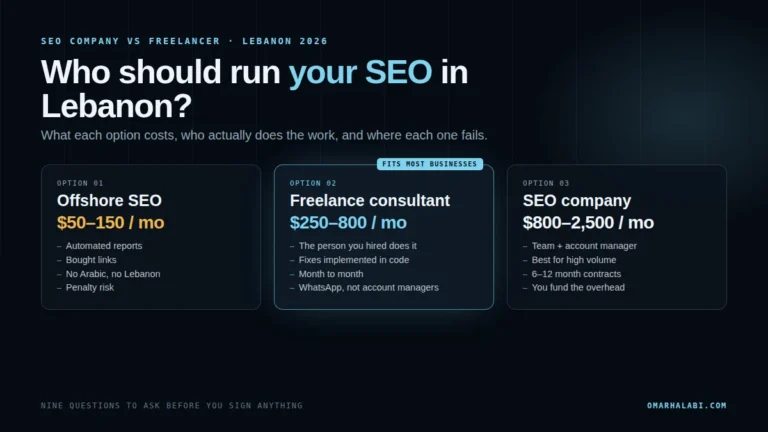
SEO Company vs Freelance SEO Consultant in Lebanon: Which Should You Hire? (2026)
Short answer: an SEO company in Lebanon charges $800 to $2,500 a month, gives you an account manager and a team, and suits large organisations with several…
SEO & AI Search · Oct 8, 2026 · 8 min read
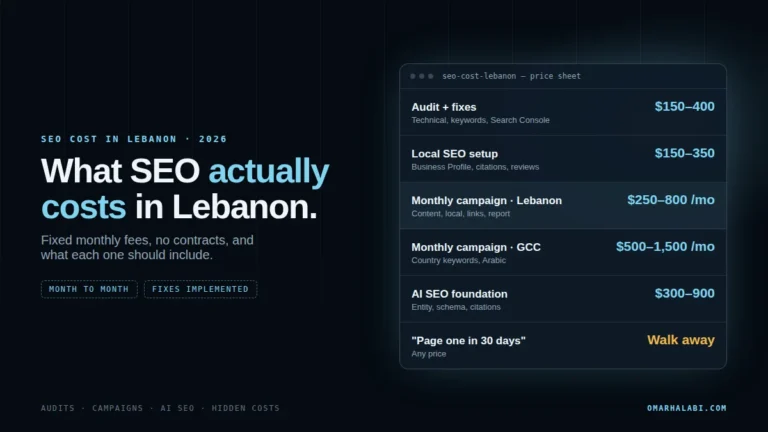
How Much Does SEO Cost in Lebanon? (2026 Prices)
Short answer: the SEO cost in Lebanon in 2026 is $250 to $800 a month for an ongoing campaign, $150 to $400 for a one-off audit with…
Read enough?
Let's build the real thing.
You'll speak directly with Omar. Free consultation, fixed USD quotes.