
AI Search Optimization in Lebanon and the GCC: The 2026 Playbook
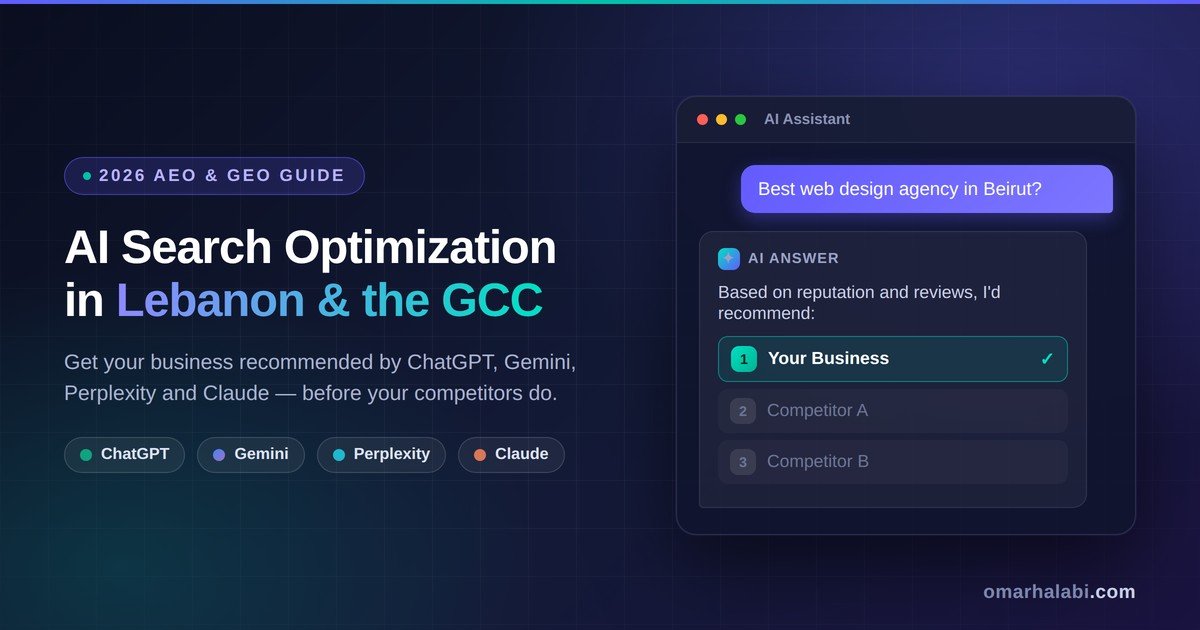
Short answer: AI search optimization in Lebanon and the GCC comes down to three things Google never required — a machine-readable identity for your business, citations on the third-party sites AI models actually trust, and content written to answer a question outright rather than to rank for a keyword. The regional advantage is that almost nobody here has done it yet.
A customer in Beirut, Dubai or Riyadh no longer opens Google and scrolls. They open ChatGPT and type “best web design agency in Beirut for a restaurant” — and they get three names. If your business is not one of those three, you did not lose a ranking. You were never in the conversation.
This is a different game from the one covered in my practical SEO guide for Lebanon and the GCC. That guide is still the foundation, and you should not skip it. This one is about what sits on top of it.
What AEO and GEO actually mean
You will see three acronyms used almost interchangeably. The distinctions are small but worth knowing:
- SEO — search engine optimization. Getting a link to your page ranked in a list of results.
- AEO — answer engine optimization. Getting your business named inside the answer itself.
- GEO — generative engine optimization. The same idea, usually used when talking about how large language models assemble responses.
For practical purposes in this article, treat AEO and GEO as one discipline: making an AI model comfortable enough with your business to say your name out loud.
The critical shift is this. Traditional SEO competes for position. AI search competes for inclusion. There is no position four in a ChatGPT answer. There are usually two to five businesses mentioned, and everyone else is invisible. That makes the distribution of winners far more brutal — and far more valuable if you are on the right side of it.
Why the opportunity is bigger in Lebanon and the Gulf than in the West
Three regional conditions make this unusually winnable right now.
The citation gap works in your favour
AI models do not know your business from your website alone. They build a picture of you from what other sites say — directories, industry listings, press, professional profiles, review platforms.
Here is the thing worth understanding about our region: run a search for agencies or service businesses in Lebanon and you will notice the same handful of sources dominating — Sortlist, Clutch, The Manifest, Entasher, and a thin scattering of local directories. That is a remarkably shallow pool compared to the US or UK, where hundreds of authoritative sources compete.
A shallow pool cuts both ways. It means AI models have less information about Lebanese businesses, so they hedge and name only the few they are confident about. It also means that establishing presence across a dozen sources can move you from invisible to consistently cited — a project that would be hopeless in a saturated Western market.
Almost nobody is competing in Arabic
Arabic is one of the least contested surfaces in AI search. English-language AEO is already crowded with agencies and SaaS companies fighting for the same prompts. Arabic prompts return thinner, less confident answers because there is far less quality Arabic source material for models to draw on.
If you publish genuinely useful Arabic content — written natively, not machine-translated — you are competing against a fraction of the field. As I argued in the SEO guide, this remains the single biggest untapped opportunity in regional search, and AI has made it more valuable, not less.
Lebanon adds a wrinkle the Gulf does not have: much of the market operates trilingually in Arabic, French and English, often mixing all three in a single conversation. A Lebanese business that establishes a consistent identity across all three languages is doing something almost no competitor has attempted.
The diaspora searches differently
A large share of revenue for Lebanese businesses comes from people who do not live in Lebanon — diaspora customers in the Gulf, Europe, West Africa and the Americas, buying for family at home or sourcing services remotely.
That buyer has no local knowledge to fall back on. They cannot ask a neighbour. They are precisely the person who asks an AI assistant “how do I find a reliable web developer in Lebanon” and acts on the answer. AI search is not a marginal channel for reaching them. It is increasingly the first one.
What the numbers actually say
It is worth being precise here, because this topic attracts a lot of invented statistics.
According to Similarweb’s analysis of generative AI traffic covering June 2025 to May 2026, monthly visits across generative AI platforms grew roughly 70% year over year to about 9.5 billion, with unique visitors up 57% to around 655 million. The category is not a niche.
The competitive picture is also shifting fast. Over that same period ChatGPT’s share of generative AI web traffic fell from roughly 76% to 53%, while Gemini climbed from about 9% to 27% and Claude from 2% to 9%. The practical lesson: optimising for ChatGPT alone is already a mistake.
Two more figures matter for planning. ChatGPT’s citation rate — how often responses link out to sources — rose from 1.6% to 6.8% over the year. And in the professional services category specifically, citation rates sit below 4%. Citations are still rare in our category, which is exactly why the businesses that earn them capture disproportionate attention.
On regional readiness, the World Bank’s World Development Report 2026: The Promise of Artificial Intelligence ranked the UAE among the world’s top ten countries for ChatGPT usage relative to internet users. Gulf customers are already there. The businesses mostly are not.
How each platform decides to mention you
The four assistants that matter regionally behave differently enough that a single tactic will not cover all of them.
ChatGPT
Leans heavily on third-party corroboration. It wants to see your business described consistently across sources it considers reputable — directories, regional publications, industry listings, professional profiles. A polished website with no external footprint rarely produces a mention.
What moves the needle: getting listed and accurately described on regional business directories, industry platforms, and any credible publication that covers your sector.
Google Gemini and AI Overviews
Draws directly on Google’s own index and, for anything local, heavily on Google Business Profile. If you have done the local SEO work in my SEO guide — complete profile, correct categories, real photos, steady review flow — you are already partway there.
What moves the needle: Google Business Profile completeness, review volume and recency, and structured data on your site.
Perplexity
The most citation-hungry of the four and the most sensitive to freshness. It favours content with visible dates, direct answers near the top, and clear sourcing.
What moves the needle: answer-first writing, visible publish and update dates, and content you genuinely maintain rather than publish and abandon.
Claude
Weighs source quality conservatively. It is comparatively cautious about naming businesses without solid grounding, and tends to prefer established industry bodies, professional associations and well-documented organisations.
What moves the needle: professional memberships, certifications, and depth of publicly documented expertise.
The playbook: eight things to do, in order
1. Let the AI crawlers in
Before anything else, check that you are not blocking the bots. Your robots.txt should not disallow:
User-agent: OAI-SearchBot        # ChatGPT search
User-agent: ChatGPT-User         # ChatGPT browsing
User-agent: PerplexityBot        # Perplexity
User-agent: Claude-SearchBot     # Claude search
User-agent: Google-Extended      # Gemini grounding
User-agent: Googlebot            # everything Google
A permissive robots.txt with Disallow: left empty is fine. What catches people out is a security plugin or host-level firewall silently blocking unfamiliar user agents. Check your server logs for these bot names — if you have never seen them, something is filtering them.
2. Fix your entity identity
An AI model needs to be certain that “Omar Halabi”, “omarhalabi.com” and the business behind them are one thing. Inconsistency creates doubt, and doubt means no mention.
Make these identical everywhere — website, Google Business Profile, LinkedIn, every directory:
- Exact business name, character for character
- Address in the same format
- Same phone number formatting, with country code
- Same core service description
- Same logo image
If you operate in Arabic as well, decide on one Arabic rendering of your business name and never vary it. Add it to your schema as an alternateName.
3. Build the citation base
This is the least glamorous step and the one that matters most. Get listed, accurately and completely, on:
- Google Business Profile (non-negotiable)
- Regional agency and service directories — Sortlist, Clutch, The Manifest and Entasher all surface heavily in regional queries
- Lebanese and Gulf business directories relevant to your sector
- LinkedIn company page, kept active
- Any chamber of commerce, professional body or certification register you legitimately qualify for
- Industry publications that accept expert contributions
Aim for accuracy over volume. Ten consistent, complete listings beat forty half-filled ones with three different phone numbers.
4. Rewrite your content answer-first
This is the biggest change to how you write, and it is genuinely uncomfortable at first.
Traditional SEO writing builds up: introduction, context, then the answer somewhere in the middle. AI extraction works the other way. Put the complete answer in the first two sentences under the heading, then explain.
Instead of:
“Website costs vary depending on many factors. There are numerous considerations to weigh when planning your budget, and every project is different…”
Write:
“A small business website in Lebanon typically costs between $800 and $2,500 in 2026. E-commerce builds run $2,500 to $8,000. The variables that move the number most are page count, custom design versus template, and payment gateway integration.”
The second version can be lifted directly into an AI answer. The first cannot.
5. Answer the questions people actually ask
AI queries are conversational and long. Nobody types “web design Beirut price” into ChatGPT — they type “how much should I expect to pay for a website for my restaurant in Beirut and how long will it take.”
Build content around those full questions. Use them verbatim as H2 and H3 headings. Every real question a client has asked you on a call is a heading waiting to be written.
6. Add the schema AI reads
Structured data is how you hand a machine an unambiguous description of your business instead of hoping it infers one correctly. At minimum implement Organization, LocalBusiness, Article and FAQPage. Ready-to-paste markup for this article is in Part 4 below.
7. Publish in Arabic properly
Not Google Translate. Native Arabic content, written by someone who knows the difference between Modern Standard Arabic and the dialect your customers actually use, with correct RTL implementation and hreflang tags connecting the language versions.
This is the highest-effort item on the list and the highest-return one, precisely because so few competitors will bother. If you are planning a site rebuild anyway, build the bilingual structure in from the start — retrofitting it later is considerably more expensive, as covered in my website development guide for Lebanon.
8. Show who is behind the content
AI models weight identifiable expertise. Anonymous content from an unnamed “team” is weak grounding. Named authors with credentials, real photos, linked professional profiles and a documented track record are strong grounding.
Put a proper author box on every post. Link your LinkedIn. If you have shipped work you can show, show it — a real portfolio is an authority signal, not just a sales page.
How to measure whether any of this is working
There is no Search Console for AI search yet, so measurement is manual. It is also not difficult.
Build a prompt list. Write 20 to 30 questions a genuine customer would ask, in every language you serve. For a Beirut web agency: “best web design company in Beirut”, “who should I hire to build an e-commerce site in Lebanon”, “أفضل شركة تصميم مواقع في لبنان”, and so on.
Test monthly, not daily. Run each prompt through ChatGPT, Gemini, Perplexity and Claude. Log whether you were mentioned, in what position, and what the model said about you. Use a temporary chat or logged-out session so personalisation does not flatter your results.
Track three things in a simple sheet: mention rate per platform, sentiment of the description, and factual accuracy of what was said.
Separate AI referrals in GA4. Create a segment filtering referral sources containing chatgpt.com, perplexity.ai, claude.ai, gemini.google.com and copilot.microsoft.com. Volume will look small at first. Watch the trend line and the conversion rate rather than the absolute number.
Read your server logs. If OAI-SearchBot and PerplexityBot are not crawling you at all, nothing downstream can work. That is the first diagnostic to run.
What it costs and how long it takes
Nobody publishes honest numbers on this, so here are mine, based on regional rates.
| Phase | Work | Realistic timeline |
|---|---|---|
| Foundation | Crawler access, entity consistency, core schema, GBP cleanup | 1–2 weeks |
| Citations | 10–15 accurate directory and platform listings | 3–6 weeks |
| Content | Rewriting existing pages answer-first, plus 3–4 new question-led articles | 2–3 months |
| Arabic layer | Native Arabic content and RTL implementation | 2–4 months |
| First measurable mentions | — | 3–6 months from start |
Budget guidance for Lebanon and the GCC: foundation work as a one-off project typically runs $500–$1,500. An ongoing retainer covering content, citation building and monthly monitoring generally sits $400–$1,200 per month, rising in the Gulf. Anyone promising AI visibility in thirty days is selling you something that does not exist.
The honest expectation: this is a compounding play. Months one and two look like nothing is happening. Month four is when businesses typically see their name start appearing.
When AI describes your business wrongly
This is the scenario nobody plans for, and it is more common than you would expect — especially for businesses with a thin citation footprint, which describes most companies in our region.
An AI assistant may state an outdated price, attribute services you do not offer, place you in the wrong city, or confuse you with a similarly named business. Because models synthesise rather than quote, you cannot simply request a correction.
What actually works:
- Find the source. Ask the assistant directly where the information came from. Often it traces back to one stale directory listing or an old page of your own.
- Correct it at origin. Update the source. Models re-crawl, and the bad data eventually ages out.
- Publish the correct version clearly. A page on your own site stating the current facts plainly, with a visible update date, gives models something better to draw on.
- Flood the gap. If a model is confusing you with another business, the fix is more unambiguous material about you — consistent name, location and service description across many sources.
- Be patient. Correction cycles run weeks, not hours.
Final thoughts
Every few years a channel opens where the barrier to entry is temporarily low, and the businesses that move early hold the position for a long time afterwards. Local SEO was that in the mid-2010s. AI search is that now — and in Lebanon and the Gulf specifically, the window is wider than it is almost anywhere else, because so few businesses have started.
None of this replaces the fundamentals. You still need a fast, well-built site, a complete Google Business Profile and content worth reading. AI search does not reward tricks; it rewards businesses that are clearly, consistently and verifiably what they claim to be. That is a harder standard than keyword optimisation ever was, and a much more durable one.
If you want help building this properly for a Lebanese or Gulf business, have a look at what I do or get in touch.
Frequently Asked Questions
What is AI search optimization and how is it different from SEO?
AI search optimization, also called AEO or GEO, is the practice of getting your business named inside AI-generated answers from tools like ChatGPT, Gemini, Perplexity and Claude. Traditional SEO competes for a ranking position in a list of links. AI search competes for inclusion in an answer that typically names only two to five businesses. The tactics overlap — both need good content and technical health — but AI search puts far more weight on third-party citations, structured data and answer-first writing.
How do I get my business recommended by ChatGPT in Lebanon or the GCC?
Start with four things: confirm you are not blocking AI crawlers in robots.txt, make your business name, address and description identical across every platform, get accurately listed on the regional directories that AI models draw from, and rewrite your key pages so the answer appears in the first two sentences of each section. Most Lebanese and Gulf businesses have done none of these, so the foundational work alone often produces results.
How long does AI search optimization take to show results?
Expect three to six months before you see consistent mentions. The foundation work takes one to two weeks, citation building three to six weeks, and content development two to three months. AI models need time to re-crawl sources and update their picture of your business. Any agency promising visibility within thirty days is not being straight with you.
Is Arabic content worth it for AI visibility?
Yes, and it is arguably the strongest single move available to a regional business. Arabic prompts return noticeably thinner and less confident AI answers than English ones because there is far less quality Arabic source material to draw on. That means less competition. The requirement is genuine native Arabic content with correct RTL implementation and hreflang tags — machine translation will not achieve this and can actively hurt you.
Which AI platform should I optimize for first?
Do not pick just one. ChatGPT’s share of generative AI traffic fell from about 76% to 53% between mid-2025 and mid-2026 while Gemini rose to roughly 27% and Claude to 9%. Gemini is usually the fastest win for a local business because it leans on Google Business Profile, which you should be maintaining anyway. Build the shared foundation — entity consistency, schema, citations, answer-first content — and it serves all four platforms.
How much does AI search optimization cost in Lebanon and the GCC?
Foundation work as a one-off project typically runs $500 to $1,500 in Lebanon, covering technical setup, schema, entity cleanup and initial citations. Ongoing work including content production, citation building and monthly monitoring generally runs $400 to $1,200 per month, with Gulf rates at the higher end. Costs scale with how much content needs rewriting and whether you are adding an Arabic layer.
Can I do this myself or do I need an agency?
The foundation is genuinely DIY-able if you are technically comfortable: checking robots.txt, cleaning up your Google Business Profile, making listings consistent and adding schema markup are all achievable in a few focused days. Where most businesses need help is sustained content production, native Arabic work, and the monthly measurement discipline that tells you whether any of it is working.

Written by
Web developer & digital advisor, Beirut
Keep reading
More guides for Lebanon & the GCC
Web Development · Sep 24, 2026 · 8 min read
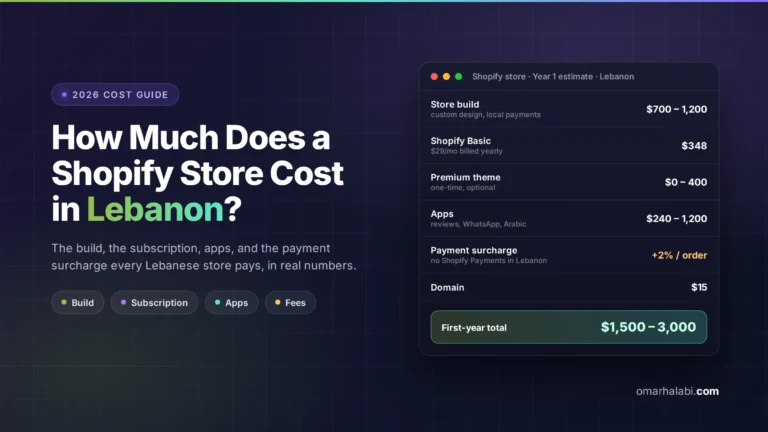
How Much Does a Shopify Store Cost in Lebanon? (2026 Guide)
Asking how much a Shopify store costs in Lebanon gets you two very different answers. Shopify's own pricing page shows a monthly plan. A developer's quote shows a…
Web Development · Sep 24, 2026 · 10 min read
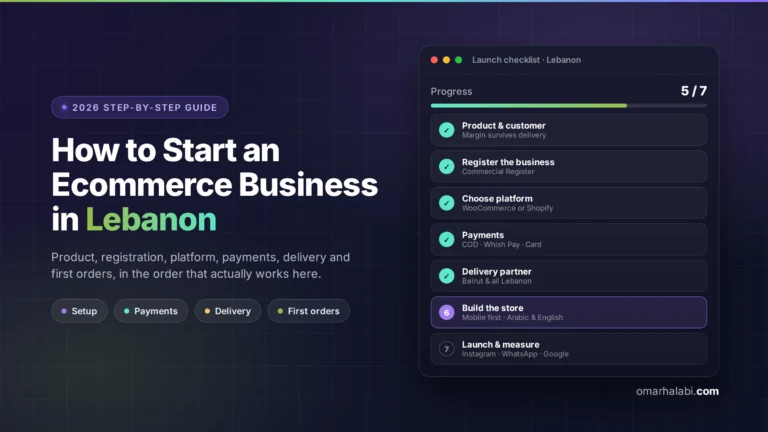
How to Start an Ecommerce Business in Lebanon: Step-by-Step Guide (2026)
If you want to start an ecommerce business in Lebanon, you are entering one of the strangest and most resilient online markets in the region. Global processors do…
Web Development · Sep 24, 2026 · 9 min read
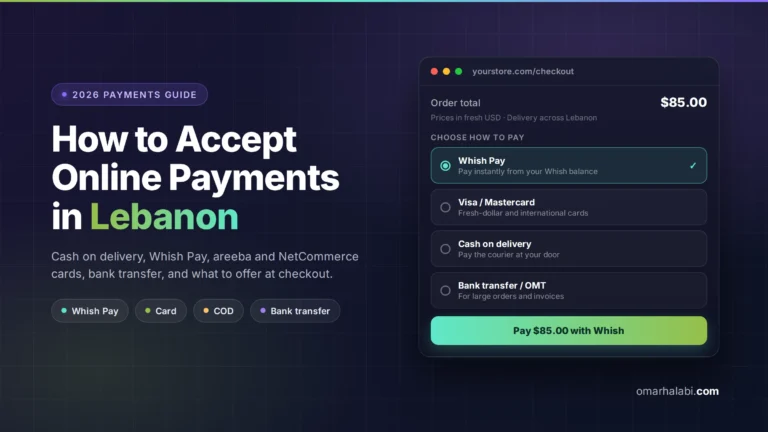
How to Accept Online Payments in Lebanon for Your Website (2026)
If you want to accept online payments in Lebanon, you will quickly discover that the advice you find on global blogs does not apply here. Stripe does not…
Read enough?
Let's build the real thing.
You'll speak directly with Omar. Free consultation, fixed USD quotes.