
Shopify vs WooCommerce in Lebanon: Which Is Better in 2026?
Choosing between Shopify vs WooCommerce in Lebanon is the first real decision you make when you open an online store. Get it right and your store runs smoothly for years. Get it wrong and you pay for it every month, in fees, in lost sales, or in a rebuild.
Most comparisons you will find online are written by a Shopify agency or a WordPress agency, and the verdict is decided before the first sentence. This one is not. It is based on building stores on both platforms for businesses in Lebanon and the GCC, and it covers what each one actually costs here, how payments really work, and which one fits your business.
Shopify vs WooCommerce in Lebanon: the short answer
If you want a quick verdict, here it is.
Choose Shopify if you want to launch fast, you do not want to think about hosting or updates, and you are happy to pay a monthly fee plus a percentage of every sale.
Choose WooCommerce if you want to own your store outright, keep transaction fees low, sell in Arabic and English, and have full control over how the checkout works.
For most small and medium businesses in Lebanon, WooCommerce wins on cost and flexibility. For fast-moving brands that sell mostly abroad and have budget for apps, Shopify can be the better tool. The rest of this article explains why.
What is the difference between Shopify and WooCommerce?
Shopify is a hosted platform. You rent your store from Shopify. They handle the servers, the security, and the software. You pay a subscription every month and you work inside their system.
WooCommerce is a free plugin that turns a WordPress website into an online store. You own the website, you choose the hosting, and you can change anything. In return, you (or your developer) are responsible for keeping it running.
That one difference, rented versus owned, drives almost every other point in this comparison.
Setup cost in Lebanon
Shopify: the platform itself is cheap to start. You pay for a theme (free, or roughly $100 to $400 one-time), then for the developer time to set up products, pages, shipping zones, and payments. Custom design work on Shopify costs more per hour than on WordPress because the templating system is more restrictive.
WooCommerce: the plugin is free, but you need a domain, hosting, a theme, and development. Because WordPress is so flexible, a proper bilingual store with custom design and local payment integration usually takes more setup work up front. That is the trade: more effort at the start, lower cost later.
In my projects, a well-built WooCommerce store and a well-built Shopify store land in a similar range at launch. The difference shows up in year two. For actual numbers, see my guide to ecommerce website development cost in Lebanon.
Monthly cost: where Shopify gets expensive
This is the part most Lebanese business owners underestimate.
| Cost item | Shopify (Basic plan) | WooCommerce |
|---|---|---|
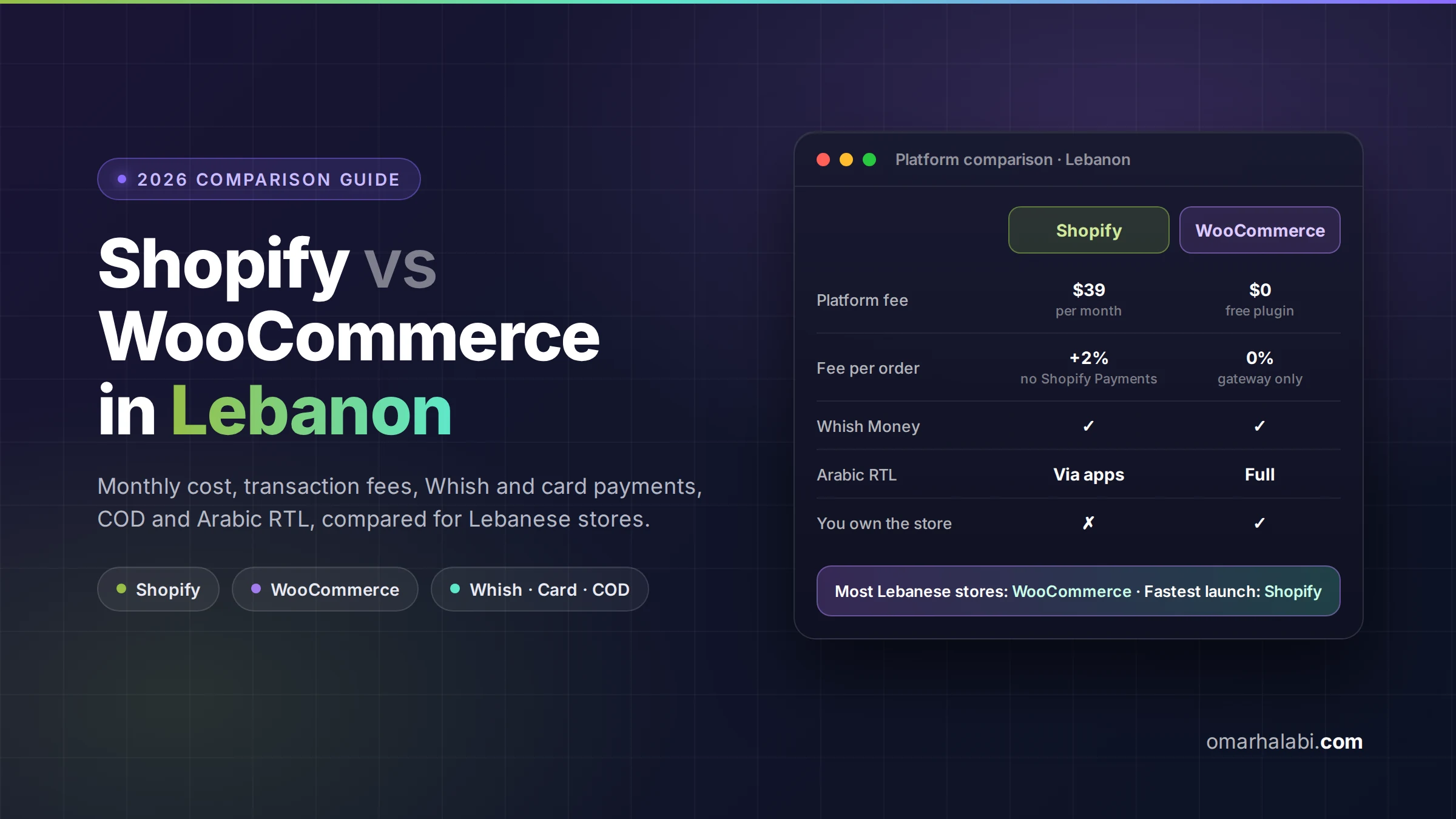
| Platform fee | $39/month, or $29/month billed yearly | $0 |
| Hosting | Included | Roughly $5 to $30/month on shared hosting, more on managed hosting |
| Domain | About $15/year | About $15/year |
| Theme | Free or one-time purchase | Free or one-time purchase |
| Apps / plugins | Many are $5 to $50/month each | Most are free; premium ones are usually yearly licences |
| Maintenance | Handled by Shopify | You or your developer |
Shopify’s Grow plan is $105/month ($79 yearly) and Advanced is $399/month ($299 yearly). You can check the latest figures on Shopify’s pricing page. A Basic store with three or four paid apps easily reaches $80 to $120 a month before you sell anything.
A WooCommerce store on good hosting with a couple of premium plugins usually runs $15 to $40 a month. Over three years, that gap is real money for a small business in Lebanon. I break the Shopify side down year by year in how much a Shopify store costs in Lebanon.
Transaction fees: the Lebanon-specific problem
Here is something most global comparison articles get wrong for our market.
Shopify’s lowest card rates only apply when you use Shopify Payments. In countries where Shopify Payments is not available, merchants have to integrate a local or third-party gateway instead. Lebanon is one of those countries. Shopify Payments and Stripe are not directly available here.
That means every Lebanese Shopify store pays two fees per order:
- The gateway’s own fee (Whish, areeba, NetCommerce, or whichever provider you use)
- Shopify’s extra third-party gateway surcharge: 2% on Basic, 1% on Grow, 0.6% on Advanced
WooCommerce charges no platform transaction fee. You pay only what your gateway charges.
On a store doing $10,000 a month on Shopify Basic, that surcharge alone is $200 a month, or $2,400 a year, on top of your subscription and gateway fees. For a Lebanese business, this is usually the deciding factor.
Payments in Lebanon: Whish, areeba, NetCommerce and COD
Payments are where a store in Beirut lives or dies. Let me go through the options I actually integrate.
Whish Money
Whish is the payment method most Lebanese customers trust. Whish has an official Whish Pay app on the Shopify App Store that takes payments directly into your Whish account. On WooCommerce, Whish provides a plugin, and I can also integrate it directly through their API for a smoother checkout.
Verdict: works on both. WooCommerce gives more control over how it appears at checkout. For the full setup on either platform, see my guide on how to accept online payments in Lebanon.
Card payments (areeba, NetCommerce)
Areeba is listed as a card payment method available to Shopify merchants targeting Lebanon. NetCommerce has direct WordPress integration and works with Shopify through third-party apps. You can see which gateways Shopify currently supports for Lebanon on Shopify’s payment providers page.
Card gateways in Lebanon generally require a registered business and a bank relationship. Confirm current requirements and fees directly with the provider before you build anything; they change.
Verdict: both platforms can take cards. Integration on WooCommerce is more direct; on Shopify, the extra surcharge applies.
Cash on delivery
COD is still a large share of ecommerce orders in Lebanon. Both platforms support it. WooCommerce has COD built in with no extra cost. On Shopify, you set it up as a manual payment method, and no Shopify surcharge applies to COD orders.
Verdict: tie, with WooCommerce slightly easier to customise (COD fees, area restrictions, and so on).
Arabic, English and RTL
Most stores I build for Lebanon and the GCC need both languages. Here the gap is large.
WooCommerce: with WPML or Polylang, you get a full Arabic version with proper right-to-left layout, translated product pages, and separate URLs that Google can index. Every part of the checkout can be translated.
Shopify: multilingual support exists through Translate & Adapt and third-party apps, and RTL depends on your theme. It works, but it is less flexible, and some apps do not translate cleanly.
If Arabic matters to your customers, WooCommerce is the stronger choice. I covered why this affects your search rankings in my guide to website development in Lebanon.
SEO: which one ranks better?
Both platforms can rank. The question is how much control you have.
WooCommerce gives you full control over URLs, meta tags, schema, page speed, and internal linking. With Yoast or Rank Math, you can optimise every product and category exactly the way you want.
Shopify has solid SEO basics, but URL structures are fixed (/products/, /collections/), and some technical settings cannot be changed. For a Lebanese store competing in Google, that matters less than good content and fast pages. Still, WooCommerce has the edge for anyone serious about SEO.
If you want to understand what actually moves rankings here, read my SEO guides for Lebanon and the GCC.
Ease of management
This one goes to Shopify.
Shopify’s admin is clean and hard to break. Updates happen automatically. If you are a one-person business and nobody technical is around, Shopify is genuinely easier to run day to day.
WooCommerce needs updates for WordPress, the theme, and plugins. Ignore them and things break. That is why I offer maintenance on every WooCommerce store I build. With maintenance in place, the day-to-day experience is very similar.
Customisation and ownership
WooCommerce: you can change anything. Custom checkout fields, delivery zones by Lebanese region, area-based COD fees, wholesale pricing, product configurators, integration with your accounting software. If you can describe it, it can be built.
Shopify: you customise through apps and Liquid templates. Checkout customisation is limited unless you are on Shopify Plus. Every extra feature tends to be another monthly app.
And on ownership: your WooCommerce store is yours. You can move hosts, change developers, or export everything. On Shopify, if your account is closed, your store is gone. For businesses in Lebanon, where things can change quickly, owning your platform is not a small point.
Selling to the GCC
Both platforms can sell to the UAE, Saudi Arabia, Kuwait and Qatar.
Shopify handles multi-currency display and international shipping reasonably well, though currency conversion adds a fee. WooCommerce does the same through plugins and gives you more control over per-country pricing and payment methods.
The bigger GCC challenge is payments and shipping, not the platform. I will cover that in a separate guide.
Shopify vs WooCommerce in Lebanon: which business should choose which?
Shopify is the better fit if you:
- Sell mostly to customers outside Lebanon
- Want to launch in weeks with minimal setup
- Have budget for a monthly subscription and apps
- Do not have anyone to maintain a website
WooCommerce is the better fit if you:
- Sell mainly in Lebanon and want Whish, cards and COD working exactly your way
- Need a proper Arabic and English store
- Want to keep monthly costs and transaction fees low
- Plan to grow and want full control over features
- Want to own your store, not rent it
Whichever way you lean, my web development and ecommerce services cover both platforms, and you can see examples of live stores in my portfolio. If Shopify is the fit, my Shopify developer in Lebanon page shows exactly what a build includes and what it costs.
Frequently asked questions
Is Shopify available in Lebanon?
Yes. You can open and run a Shopify store from Lebanon. Shopify Payments is not available here, so you connect a third-party gateway such as Whish or a card provider, and Shopify adds its third-party surcharge on each order.
Is WooCommerce free in Lebanon?
The WooCommerce plugin is free. You pay for hosting, a domain, any premium plugins, and development. There is no platform transaction fee.
Can I use Whish on Shopify and WooCommerce?
Yes. Whish has an official Shopify app and provides a WordPress plugin. Both let customers pay from their Whish balance and settle directly to your Whish account.
Which is better for a small business in Lebanon?
For most small businesses selling locally, WooCommerce is more cost-effective and handles Arabic and local payments better. Shopify makes sense if you sell abroad and want the simplest possible management.
Can I switch from Shopify to WooCommerce later?
Yes. Products, customers and orders can be exported and imported. It takes work, so it is better to choose correctly the first time.
Final thoughts
Shopify vs WooCommerce in Lebanon comes down to three questions: who are your customers, which payment methods do they use, and do you want to rent or own your store. For most Lebanese businesses, those answers point to WooCommerce. For some, Shopify is the right call.
If you are still unsure, I build stores on both platforms. That means I can recommend the one that fits your business, rather than the platform I am trying to sell. And if you are earlier than that, start with my step-by-step guide on how to start an ecommerce business in Lebanon.
Tell me what you sell and where, and I will give you a straight answer. Contact me for a free consultation or WhatsApp me on +961 70 884 941.
Last verified: September 2026. Platform prices and gateway availability change; I update this article when they do.

Written by
Web developer & digital advisor, Beirut
Keep reading
More guides for Lebanon & the GCC
Web Development · Sep 24, 2026 · 8 min read
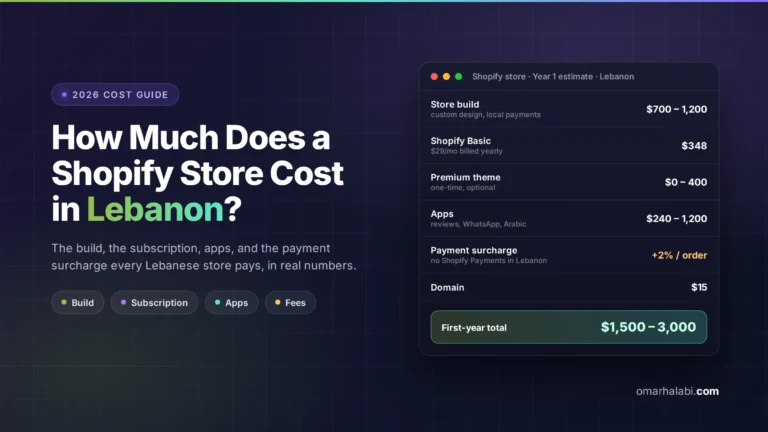
How Much Does a Shopify Store Cost in Lebanon? (2026 Guide)
Asking how much a Shopify store costs in Lebanon gets you two very different answers. Shopify's own pricing page shows a monthly plan. A developer's quote shows a…
Web Development · Sep 24, 2026 · 10 min read
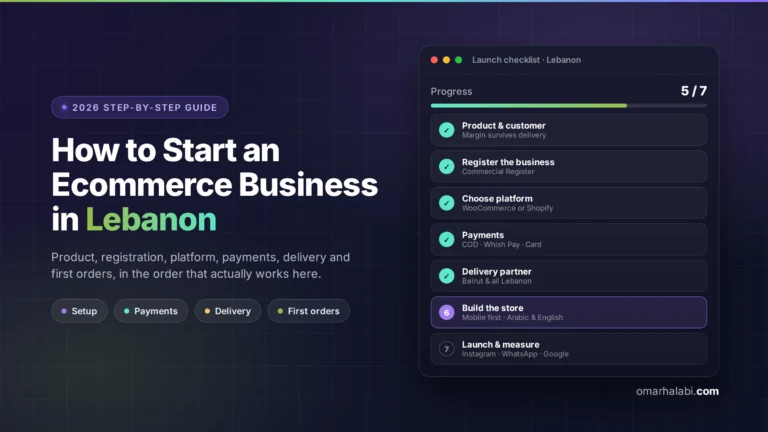
How to Start an Ecommerce Business in Lebanon: Step-by-Step Guide (2026)
If you want to start an ecommerce business in Lebanon, you are entering one of the strangest and most resilient online markets in the region. Global processors do…
Web Development · Sep 24, 2026 · 9 min read
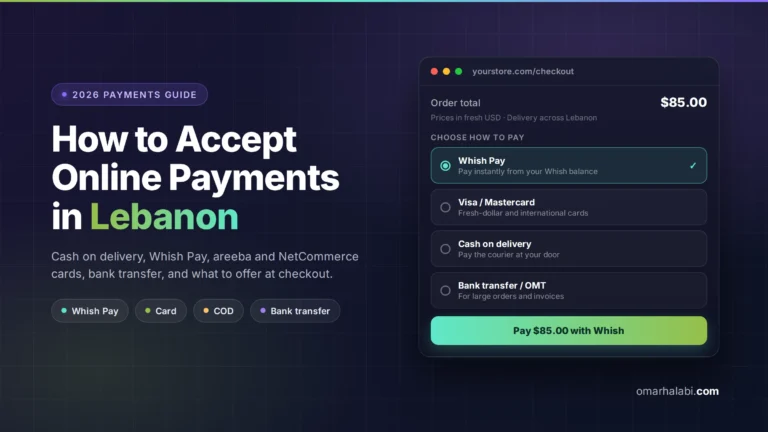
How to Accept Online Payments in Lebanon for Your Website (2026)
If you want to accept online payments in Lebanon, you will quickly discover that the advice you find on global blogs does not apply here. Stripe does not…
Read enough?
Let's build the real thing.
You'll speak directly with Omar. Free consultation, fixed USD quotes.