
How to Start an Ecommerce Business in Lebanon: Step-by-Step Guide (2026)
If you want to start an ecommerce business in Lebanon, you are entering one of the strangest and most resilient online markets in the region. Global processors do not work here, cash still dominates, and yet Lebanese stores keep launching, selling locally, to the diaspora, and across the GCC.
This is the step-by-step guide I wish every client had read before we started building. It covers what to sell, how to set up legally, which platform to use, how to get paid, how to deliver, and how to get your first orders. It is written for Lebanon in 2026, not copied from a guide for another country.
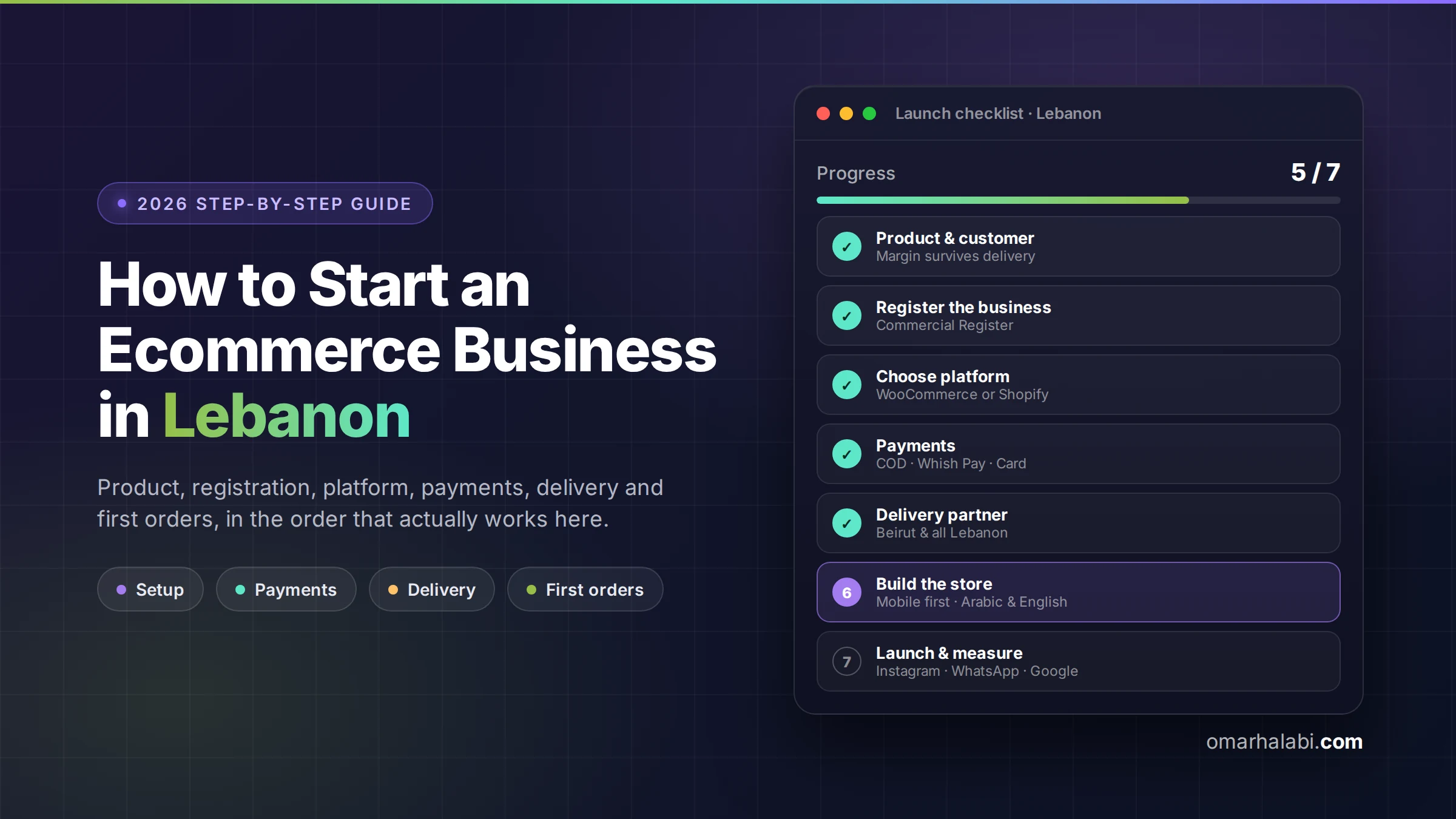
Start an ecommerce business in Lebanon: the roadmap
Here is the whole process in one view. The rest of the article goes through each step.
- Choose a product and a customer you can actually serve
- Decide who you sell to: Lebanon, the diaspora, the GCC, or a mix
- Register the business, or plan when you will
- Choose your platform
- Set up payments that work in Lebanon
- Set up delivery and returns
- Build the store properly
- Launch, get your first orders, and measure
Step 1: Choose a product and a customer you can actually serve
Most Lebanese ecommerce failures are not technical. They are stores that sell something nobody was looking for, at a price that does not cover delivery and returns.
Before anything else, answer three questions:
- Who is the buyer? A specific person in a specific place, not “everyone in Lebanon.”
- Why buy from you instead of Instagram or a shop in Hamra? Better range, better price, convenience, or something they cannot get elsewhere.
- Does the margin survive delivery? If a courier costs a few dollars per order and you sell a $12 item, you have no business yet.
Products that tend to work well online in Lebanon: beauty and skincare, clothing and accessories, specialty food and gifts, home goods, electronics accessories, and anything the diaspora wants sent to family.
Step 2: Decide who you sell to
This decision shapes everything else, so make it early.
Selling inside Lebanon: you need cash on delivery, Whish Pay, a local courier, and Arabic and English content. Prices in USD.
Selling to the diaspora: you need international cards, international shipping through Aramex or DHL, and a checkout that works for someone paying from Paris or Montreal for a delivery in Tripoli.
Selling to the GCC: you need a regional payment option, shipping costs that do not kill the sale, and often Arabic-first content. I cover the platform side of this in my comparison of Shopify vs WooCommerce in Lebanon.
Many successful Lebanese stores start local, add the diaspora after a few months, and only look at the Gulf once they have repeat customers.
Step 3: Register the business, or plan when you will
You can test an idea in Lebanon without a registered company, and many people start by selling through Instagram and WhatsApp. But there is a limit to how far you can go.
Card payment gateways such as areeba and NetCommerce require a registered business. Corporate accounts with couriers such as Aramex are opened for businesses. And issuing invoices to companies or GCC customers needs a legal entity.
Companies in Lebanon are registered with the Commercial Register under the Ministry of Justice, which has a central portal at cr.justice.gov.lb. The common structures are a sole trader registration or a SARL. Which one fits you, and what it costs, is a question for an accountant, not a web developer. I recommend a short consultation before you register, because the structure also affects which payment gateways you can use.
Practical path: start with cash on delivery and Whish Pay, which do not require a merchant bank account, and register when you are ready to add card payments and courier accounts.
Step 4: Choose your platform
You have three realistic options.
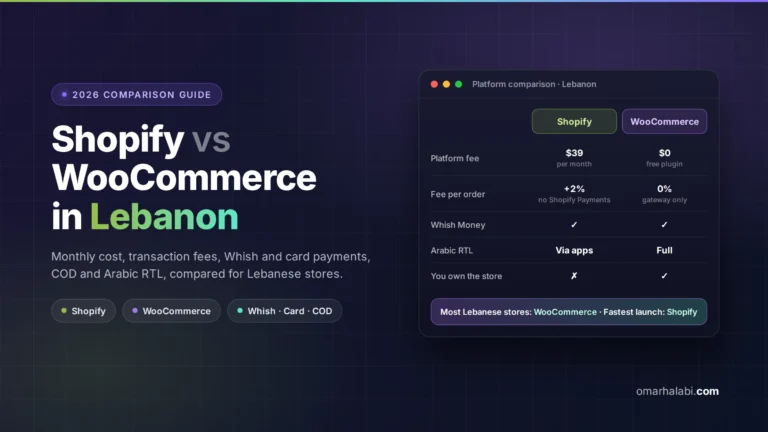
WooCommerce (WordPress): you own the store, pay no platform transaction fee, and can integrate any Lebanese payment method exactly the way you want. Best for stores selling mainly in Lebanon, bilingual stores, and anyone who wants full control.
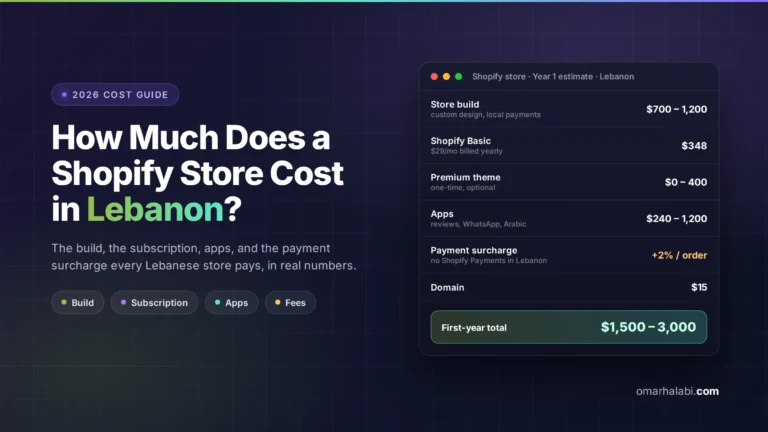
Shopify: fastest to launch and easiest to run, but Shopify Payments is not available in Lebanon, so you pay an extra surcharge on every order that goes through a local gateway. Best for brands selling mostly abroad with budget for apps. If that is you, my Shopify developer in Lebanon page covers what a build includes, and how much a Shopify store costs in Lebanon gives the full first-year budget.
Marketplaces: selling on regional marketplaces gives you reach but takes your margin and your customer data. Useful as an extra channel for standardised products, not as your main business.
For a full breakdown of costs and trade-offs, read Shopify vs WooCommerce in Lebanon. For what a store costs to build, see my ecommerce website development cost guide.
Step 5: Set up payments that work in Lebanon
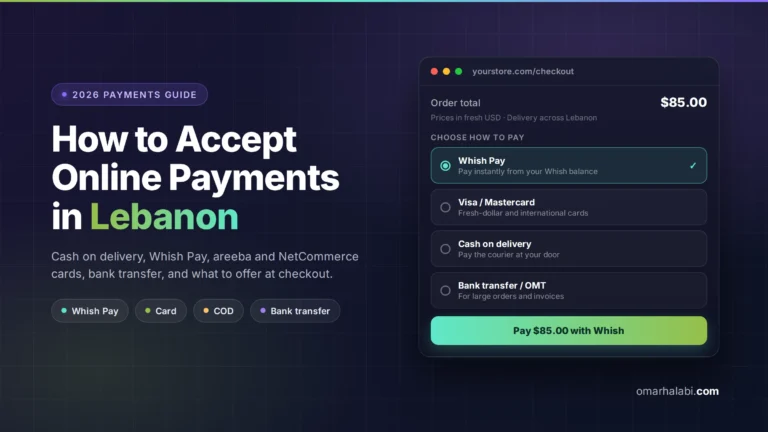
This is where most guides written outside Lebanon become useless. Stripe does not support Lebanese businesses and PayPal is restricted. What works:
- Cash on delivery for local customers, still the most used method
- Whish Pay for instant wallet payments, integrated with Shopify, WordPress, and custom sites
- areeba or NetCommerce for Visa and Mastercard once you are registered
- Bank transfer or OMT for large orders and B2B
- International cards for diaspora and GCC buyers, through a Lebanese gateway or a foreign company structure
Offer two or three methods, not all of them, and test each one with a real order before launch. I wrote a full guide on this: how to accept online payments in Lebanon.
Step 6: Set up delivery and returns
Delivery is where Lebanese ecommerce lives or dies. A late or lost parcel loses the customer forever.
Inside Lebanon: the established options are Wakilni, which specialises in ecommerce, LibanPost, and Aramex. Many Beirut stores also use smaller local couriers. Compare coverage outside Beirut, cash collection for COD orders, and how they handle refused deliveries before you commit.
International: Aramex and DHL are the standard for diaspora and GCC orders. Both require a business account, which is another reason to register.
Returns and refused COD orders: a share of cash-on-delivery orders get refused at the door. Confirm large orders by WhatsApp before dispatch, and agree with your courier on who pays for the return trip. Build this cost into your prices.
Delivery zones and fees: set different fees for Beirut, Mount Lebanon, and the rest of the country. On WooCommerce and Shopify this is straightforward, and it stops you losing money on remote deliveries.
Step 7: Build the store properly
A store that looks like a template with stock photos does not earn trust in Lebanon. What matters:
- Mobile first. Most of your orders will come from a phone, often through an Instagram or WhatsApp link.
- Arabic and English if your customers use both. A proper RTL layout, not a machine-translated afterthought.
- Clear currency. State that prices are in fresh USD, and how LBP is handled if you accept it.
- WhatsApp on every page. Lebanese customers ask before they buy. Make it easy.
- Real product photos, shot in Lebanon, with sizes, ingredients, or specifications written out.
- Fast loading. Many customers are on mobile data with weak signal. A heavy store loses them.
- Technical SEO from day one: clean URLs, product schema, and category pages that can rank for what people in Lebanon search for.
If you are choosing a developer, my guide to website development in Lebanon lists the red flags to watch for and realistic timelines.
Step 8: Launch, get your first orders, and measure
Your website will not bring customers on its own in the first weeks. Your first orders come from:
- Instagram and TikTok, where most Lebanese product discovery already happens
- WhatsApp broadcasts to existing contacts and past customers
- Family and friends placing real orders and leaving real reviews
- Google Business Profile, so local searches find you
- A small paid budget on Instagram once you know which product sells
After launch, track four numbers every week: visitors, orders, refused deliveries, and which channel each order came from. Everything you decide in month two should come from those numbers, not from guesses.
How much does it cost to start an ecommerce business in Lebanon?
The store itself is a fixed cost, and my ecommerce cost guide gives real ranges from projects I build. Beyond that, budget for:
- Business registration and accountant fees
- First inventory, packaging, and product photography
- Courier setup and a buffer for refused deliveries
- Hosting, domain, and any plugin or app subscriptions
- A small marketing budget for the first three months
Most small Lebanese stores can launch for a few thousand dollars including inventory. Service businesses selling through a simple site can launch for much less.
Mistakes I see most often
- Building the store before deciding who the customer is
- Launching without cash on delivery
- Sending customers to payment links instead of a real checkout
- No delivery partner agreed before the first order
- One-language stores for a bilingual customer base
- Ignoring the diaspora, who spend more per order than local buyers
- Treating the website as the marketing plan
Frequently asked questions
Do I need a registered company to sell online in Lebanon?
Not to start. Cash on delivery and Whish Pay work without a merchant bank account. You will need to register once you want card payments, courier business accounts, or to invoice companies.
Which platform is best for an online store in Lebanon?
For most stores selling locally, WooCommerce, because it handles Lebanese payment methods and Arabic content with no platform transaction fee. Shopify is a good choice if you sell mostly abroad and want the simplest management.
How do customers pay on a Lebanese online store?
Mostly cash on delivery and Whish Pay, with cards through areeba or NetCommerce for registered businesses, and bank transfer for large orders.
Who delivers for online stores in Lebanon?
Wakilni, LibanPost, and Aramex are the established local options, with Aramex and DHL for international orders. Many Beirut stores also work with smaller local couriers.
Can I sell to the GCC from Lebanon?
Yes. You need international shipping, a payment option that works for Gulf customers, and pricing that stays competitive after shipping. Most stores add the GCC after they have a stable local business.
Final thoughts
To start an ecommerce business in Lebanon, you build around how Lebanese customers actually buy: on their phones, through Instagram and WhatsApp, paying in cash or Whish, and expecting fast delivery. Get the product, payments, and delivery right, and the store is the easy part.
I build online stores for businesses across Lebanon and the GCC, on WooCommerce, Shopify, and custom platforms, with local payments and delivery set up and tested before launch. If you are planning a store, contact me for a free consultation or WhatsApp me on +961 70 884 941, and see live examples in my portfolio.
Last verified: September 2026. Regulations, gateways, and courier services in Lebanon change; I update this article when they do.

Written by
Web developer & digital advisor, Beirut
Keep reading
More guides for Lebanon & the GCC
Web Development · Sep 24, 2026 · 8 min read
How Much Does a Shopify Store Cost in Lebanon? (2026 Guide)
Asking how much a Shopify store costs in Lebanon gets you two very different answers. Shopify's own pricing page shows a monthly plan. A developer's quote shows a…
Web Development · Sep 24, 2026 · 9 min read
How to Accept Online Payments in Lebanon for Your Website (2026)
If you want to accept online payments in Lebanon, you will quickly discover that the advice you find on global blogs does not apply here. Stripe does not…
Web Development · Sep 24, 2026 · 10 min read
Shopify vs WooCommerce in Lebanon: Which Is Better in 2026?
Choosing between Shopify vs WooCommerce in Lebanon is the first real decision you make when you open an online store. Get it right and your store runs smoothly…
Read enough?
Let's build the real thing.
You'll speak directly with Omar. Free consultation, fixed USD quotes.