
How to Accept Online Payments in Lebanon for Your Website (2026)
If you want to accept online payments in Lebanon, you will quickly discover that the advice you find on global blogs does not apply here. Stripe does not support Lebanese businesses. PayPal is limited. And most of your customers still want to pay in ways that international guides never mention.
The good news is that a Lebanese website can take payments reliably in 2026, from Whish to fresh-dollar cards to cash on delivery. This guide covers every option that actually works, which one fits which business, and how to set them up without losing sales at checkout.
Accept online payments in Lebanon: the short answer
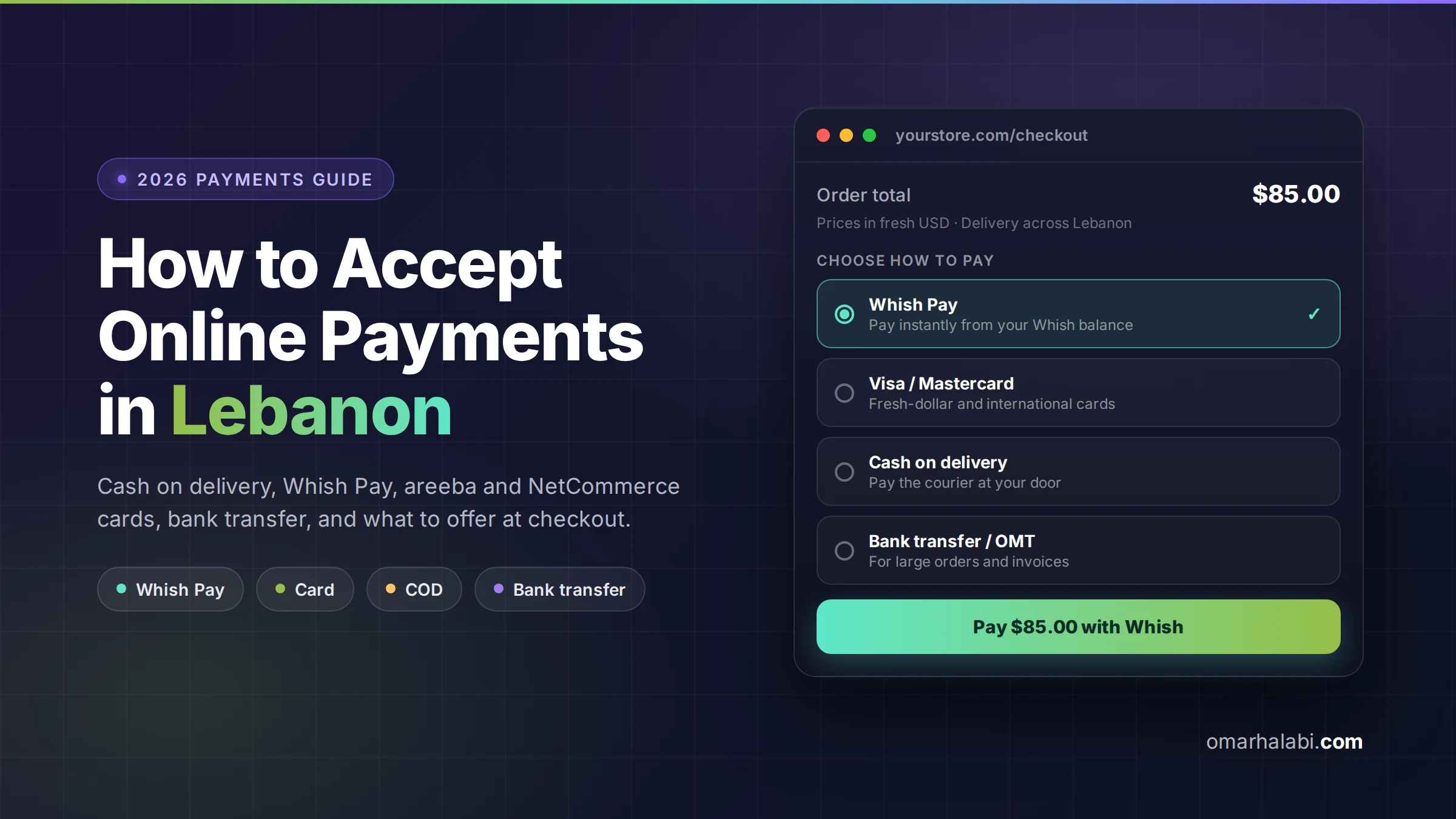
For a store selling mainly inside Lebanon, the setup that works in 2026 is:
- Cash on delivery as the default, because most local customers still expect it
- Whish Pay for instant wallet payments from a customer’s Whish balance
- A card gateway such as areeba or NetCommerce for fresh-dollar and international cards
- Bank transfer or OMT for large orders and B2B invoices
If you also sell to the diaspora or the GCC, you add an international card option on top. The rest of this article explains each one.
Why accepting payments in Lebanon is different
Three things make Lebanon unusual.
First, the global processors are missing. Stripe does not officially support Lebanese-registered businesses, and PayPal is restricted for receiving money. You cannot copy a checkout setup from a US or European tutorial.
Second, trust in card payments dropped after 2019. Many customers prefer to hand cash to the delivery driver or send money through a wallet they already use every day.
Third, there are two kinds of dollars. Customers pay with fresh-dollar cards, Whish balances in USD or LBP, or cash. Your payment stack needs to handle all of them without confusing the buyer.
I explain how this affects your whole website build in my guide to website development in Lebanon.
Payment methods that work in Lebanon in 2026
Cash on delivery
Still the most used method for local ecommerce. Customers order online and pay the courier in cash when the parcel arrives.
How to set it up: WooCommerce has COD built in. On Shopify, you add it as a manual payment method. Both let you limit COD to specific areas and add a small COD fee if you want to encourage online payment.
Watch out for: fake orders and refused deliveries. Confirm large COD orders by WhatsApp before dispatch, and ask your courier about their return policy on refused parcels.
Best for: every store selling inside Lebanon. Do not launch without it.
Whish Pay
Whish Pay is the wallet payment gateway from Whish Money. Customers pay directly from their Whish balance, and the money lands in your Whish merchant account. It integrates with Shopify, WordPress, and custom websites.
How to set it up: open a Whish merchant account, install the Whish Pay app on Shopify or the plugin on WooCommerce, and connect your credentials. On a custom site, I integrate it through their API so the customer never leaves your checkout.
Watch out for: payment links. Sending a customer a Whish link outside your checkout works, but it breaks the flow and lowers conversion. Use the proper integration.
Best for: any business whose customers are inside Lebanon. In my experience it is the fastest local method to integrate and the one customers trust most.
Card gateways: areeba and NetCommerce
These are the Lebanese card acquirers. They connect to Lebanese banks and let you take Visa and Mastercard payments, including fresh-dollar cards and international cards.
areeba works with major Lebanese banks and supports multiple currencies. It is what many established Lebanese brands run on. Onboarding involves paperwork and a bank relationship, so it takes longer than a wallet.
NetCommerce has been processing card payments in Lebanon since 1999 and supports USD and LBP, recurring billing, and payment links. It has direct WordPress integration and works with Shopify through third-party apps.
How to set it up: you need a registered business and a merchant account with the gateway. Once approved, you install their plugin or integrate their hosted checkout. Ask them directly for current fees and settlement times; they change and depend on your volume.
Best for: registered businesses with steady sales that want to accept cards from Lebanese and foreign customers.
Bank transfer and OMT
For high-value orders, B2B invoices, and customers who prefer not to pay online, a manual bank transfer or an OMT transfer still works.
How to set it up: add “Bank transfer” or “OMT” as a manual payment method with instructions on the checkout page. The order stays on hold until you confirm the money arrived.
Best for: furniture, equipment, wholesale, services, and anything over a few hundred dollars.
International cards for diaspora and GCC customers
If a large share of your buyers is outside Lebanon, you have two routes.
The first is a Lebanese card gateway that accepts international cards. This is the simplest if your business is registered in Lebanon.
The second is a foreign company structure, for example in the UAE, US, or EU, which opens the door to processors such as 2Checkout or Paddle. This is cleaner for pure diaspora sales but it is a legal and accounting decision, not just a technical one. Talk to an accountant before choosing it.
For GCC customers specifically, gateways such as MyFatoorah cover Lebanon and the Gulf together, though onboarding requirements vary. I cover the platform side of selling to the Gulf in my comparison of Shopify vs WooCommerce in Lebanon.
Which payment methods should your website offer?
Do not offer everything. Offer what your customers actually use.
| Business type | Offer at checkout |
|---|---|
| Local retail store (clothing, beauty, food) | COD, Whish Pay, card |
| Restaurant or delivery | COD, Whish Pay |
| Services and bookings | Whish Pay, card, bank transfer |
| Furniture, equipment, wholesale | Bank transfer, OMT, card, deposit via Whish |
| Selling to diaspora abroad | International card, Whish for local family members |
| Selling to the GCC | International card, regional gateway, plus local methods |
Every extra method you add is one more thing to test, reconcile, and support. Start with two or three and add more when customers ask.
How to set up online payments in Lebanon step by step
Step 1: Decide where the money will land
Before you touch any plugin, decide which account receives payments: a Whish merchant account, a Lebanese bank account for card settlements, a foreign account, or a mix. This decides which gateways you can use.
Step 2: Register the business if you plan to take cards
Card gateways require a registered business. Whish and COD do not have the same requirement, which is why many small stores start with those two and add cards later.
Step 3: Choose your platform
WooCommerce and Shopify both support all the methods above. WooCommerce gives you more control over local integrations and charges no platform transaction fee; Shopify adds a surcharge when you use a third-party gateway, which is every gateway in Lebanon. The full comparison is in my Shopify vs WooCommerce guide.
Step 4: Integrate properly, not with links
Install the official Whish Pay app or plugin, the gateway’s own plugin, and configure COD and bank transfer as manual methods. Avoid sending customers off-site to pay. Every redirect costs you orders.
Step 5: Show prices in the currency your customers think in
For most Lebanese stores that is USD. Make it clear whether the price is in fresh dollars, and if you accept LBP through Whish, state the rate you apply.
Step 6: Test every method with a real order
Place a test order with each payment method, on mobile, before launch. Check that the order status updates, the confirmation email arrives, and the money shows up where you expected. Most payment problems I fix for clients are configuration mistakes that a single test order would have caught.
Step 7: Reconcile weekly
Match orders to Whish, bank, and cash receipts every week. It takes twenty minutes and it stops small mistakes from becoming accounting problems.
Mistakes that lose sales at checkout
- Only offering cards. A large share of Lebanese customers will leave.
- Only offering COD. You lose diaspora and GCC buyers entirely and carry all the refused-delivery risk.
- Redirecting to a payment link. Customers assume the site is broken or unsafe.
- Hiding the currency. “$” without saying fresh dollars creates arguments at the door.
- No WhatsApp confirmation for large COD orders. One fake order can cost more than a month of gateway fees.
- Launching without a test order. Every method, on a phone, before you go live.
Frequently asked questions
Can I use Stripe in Lebanon?
Not with a Lebanese-registered business. Stripe does not officially support Lebanon. Some merchants use a foreign company to open a Stripe account, but that is a legal and tax decision, not a workaround to take lightly.
Does PayPal work for a Lebanese website?
PayPal is restricted in Lebanon and is not reliable for receiving payments into a Lebanese account. It is not a solution for a local store.
What is the easiest way to accept payments on a small website in Lebanon?
Cash on delivery plus Whish Pay. Both can be live in a day on WooCommerce or Shopify, and neither requires a bank merchant account.
Do I need a registered company to accept online payments in Lebanon?
For Whish Pay and cash on delivery, generally no. For a card gateway such as areeba or NetCommerce, yes. Confirm the current requirements with the provider.
Can my Lebanese website accept payments from the GCC?
Yes. A Lebanese card gateway that accepts international cards covers most cases. If GCC sales become a large share of your business, a regional gateway that supports both Lebanon and the Gulf is worth considering.
Final thoughts
To accept online payments in Lebanon, you build for the customers you actually have: cash on delivery for trust, Whish Pay for speed, a card gateway once you are registered, and bank transfer for large orders. Add international cards only when your buyers abroad justify it.
I set up all of these for the stores I build, on WooCommerce, Shopify, and custom platforms, and I test every method before launch. If you want to know which combination fits your business, contact me for a free consultation or WhatsApp me on +961 70 884 941. You can also see examples of live Lebanese stores in my portfolio.
Last verified: September 2026. Gateway availability, requirements, and fees in Lebanon change often; I update this article when they do.

Written by
Web developer & digital advisor, Beirut
Keep reading
More guides for Lebanon & the GCC
Web Development · Sep 24, 2026 · 8 min read
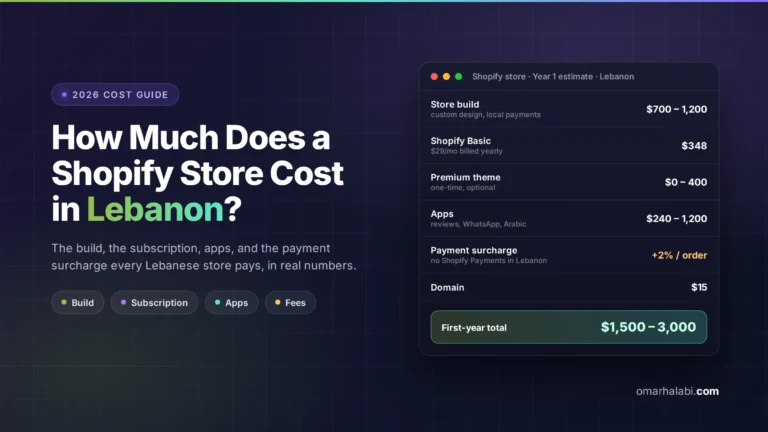
How Much Does a Shopify Store Cost in Lebanon? (2026 Guide)
Asking how much a Shopify store costs in Lebanon gets you two very different answers. Shopify's own pricing page shows a monthly plan. A developer's quote shows a…
Web Development · Sep 24, 2026 · 10 min read
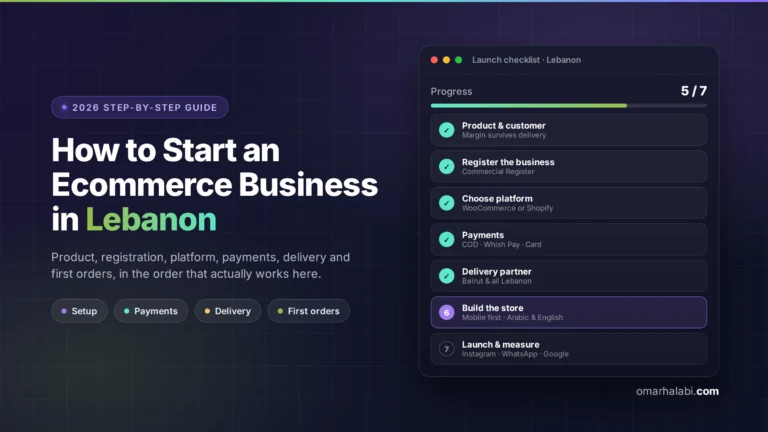
How to Start an Ecommerce Business in Lebanon: Step-by-Step Guide (2026)
If you want to start an ecommerce business in Lebanon, you are entering one of the strangest and most resilient online markets in the region. Global processors do…
Web Development · Sep 24, 2026 · 10 min read
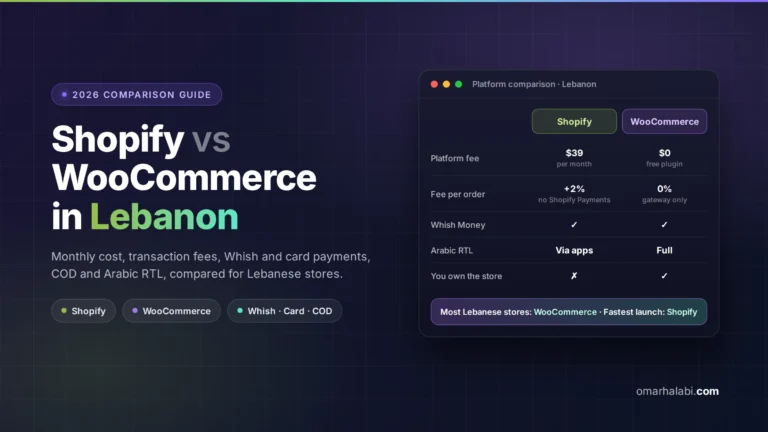
Shopify vs WooCommerce in Lebanon: Which Is Better in 2026?
Choosing between Shopify vs WooCommerce in Lebanon is the first real decision you make when you open an online store. Get it right and your store runs smoothly…
Read enough?
Let's build the real thing.
You'll speak directly with Omar. Free consultation, fixed USD quotes.