
How Websites Work

Introduction
Have you ever wondered how websites work? From browsing your favorite online store to reading blogs, websites are the backbone of our digital experience. In this article, we’ll explore the fundamentals of how websites work, including the key technologies and processes involved in their operation. If you want to dive deeper into how to create a website, check out our detailed guide on how to create a website.
What Is a Website?
A website is a collection of interconnected web pages stored on a server and accessed through a browser. Websites are designed with a purpose—whether it’s to share information, sell products, or entertain users. Understanding how websites work is essential to knowing how to build and manage a website effectively.
The Building Blocks of How Websites Work
Domain Name: The Address of the Web
The domain name is a website’s unique address (e.g., www.omarhalabi.com). It’s what you type into your browser to access a specific site, and it’s the first step in understanding how websites work.
Hosting: Where Websites Live
Websites are stored on servers, powerful computers that deliver the website’s content to your browser upon request. Without hosting, a website cannot function online. Want to learn more about website hosting? Check out our blog on choosing the best hosting for your website.
Frontend and Backend: Two Sides of a Website
- Frontend: This is the visual part of a website—the design, buttons, and images you interact with.
- Backend: The backend handles data processing, user requests, and ensures everything runs smoothly.
How Websites Operate
Accessing a Website
When you type a website’s URL into your browser, it sends a request to the server where the website is hosted. This process is a crucial step in understanding how websites work.
Data Transmission
The server processes your request and sends back the necessary files (HTML, CSS, JavaScript) to your browser.
Rendering the Webpage
Your browser translates these files into a webpage, allowing you to interact with buttons, forms, and other elements.
Conclusion
Websites are the backbone of the internet, supporting businesses, education, and entertainment. By understanding how websites work, you’re better prepared to create your own website or appreciate the technology behind it.

Written by
Web developer & digital advisor, Beirut
Keep reading
More guides for Lebanon & the GCC
Web Development · Oct 8, 2026 · 9 min read
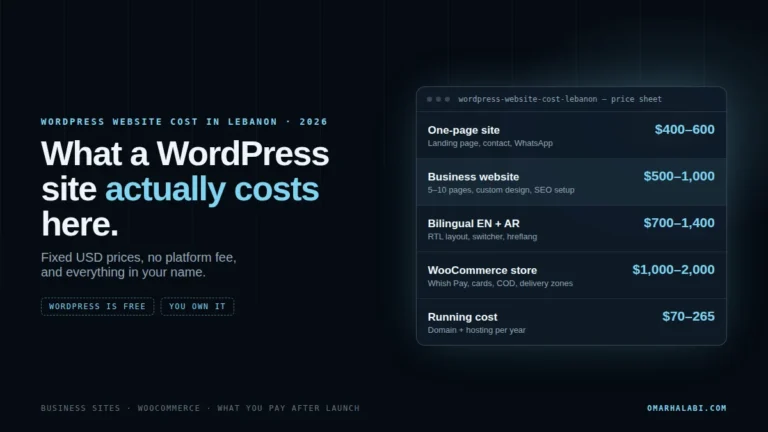
How Much Does a WordPress Website Cost in Lebanon? (2026)
Short answer: a WordPress website cost in Lebanon runs $500 to $1,000 for a professional business website in 2026, and $1,000 to $2,000 for a WooCommerce online…
Web Development · Sep 27, 2026 · 12 min read
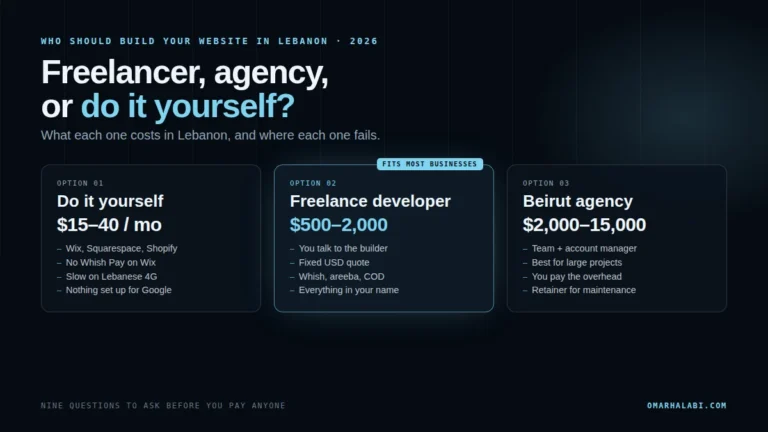
Who Should Build Your Website in Lebanon? Freelancer, Agency or DIY (2026)
Short answer: if you want to hire a web developer in Lebanon, you have three real options. A freelance developer costs $500 to $2,000, you deal with…
Web Development · Sep 24, 2026 · 8 min read
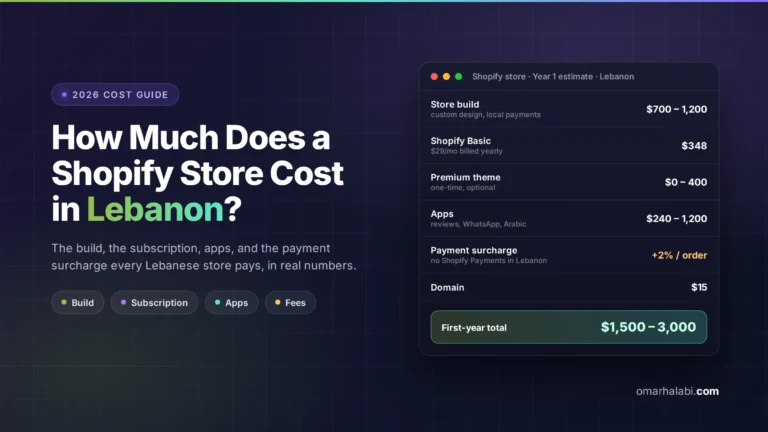
How Much Does a Shopify Store Cost in Lebanon? (2026 Guide)
Asking how much a Shopify store costs in Lebanon gets you two very different answers. Shopify's own pricing page shows a monthly plan. A developer's quote shows a…
Read enough?
Let's build the real thing.
You'll speak directly with Omar. Free consultation, fixed USD quotes.